Page 1 of 2
Everwood Avenue Brewery Build
Posted: Thu Nov 08, 2012 1:59 pm
by GillettBreweryCnslt
Hi Everyone,
Well, after careful consideration and an irrational need to always be building and improving my system, I've decided to go electric. But first...
I've been brewing for about 12 years, seriously for about 3 and AG for the last 2. About 6 months ago I moved from stove-top 5 gallon to a 10 gallon BK / cooler MTL. One thing lead to another and here I am, upgrading my system to a Brutus 10e style system. I mostly blame my OCD and this forum for my I've almost acquired everything I need, I've got everything for the mechanical side of the build, just waiting on a few electrical details.
I'm going to do a Kal (electricbrewery.com) inspired control box, as most of the ones I've seen are, and a 2X 4500W single tier, 3 vessel system. I will eventually move into a HERMS system, but if I want to be brewing on this new electric system by Xmas (my goal), I'll need to build in stages (due to the lack of available financing from SWMBO). So for now, I'm simply going to insulate my MLT keg with Roxul for heat retention and see how it goes. I've always got my cooler MLT to fall back on if the insulation is not sufficient. I've got 2 50L Euro Sankes for my HLT and MLT and a 58L Sanke for my BK. I'll be cutting the bottoms and using tri-clover fittings for the drains.
So, last night I decided to go ahead and start the control panel (mostly figuring out design). I'm still working on the wiring diagram and I very much open to suggestions, but I'm not in a rush or completely set on the design (until I cut the holes in the control panel!).
Here's what I have to start with:
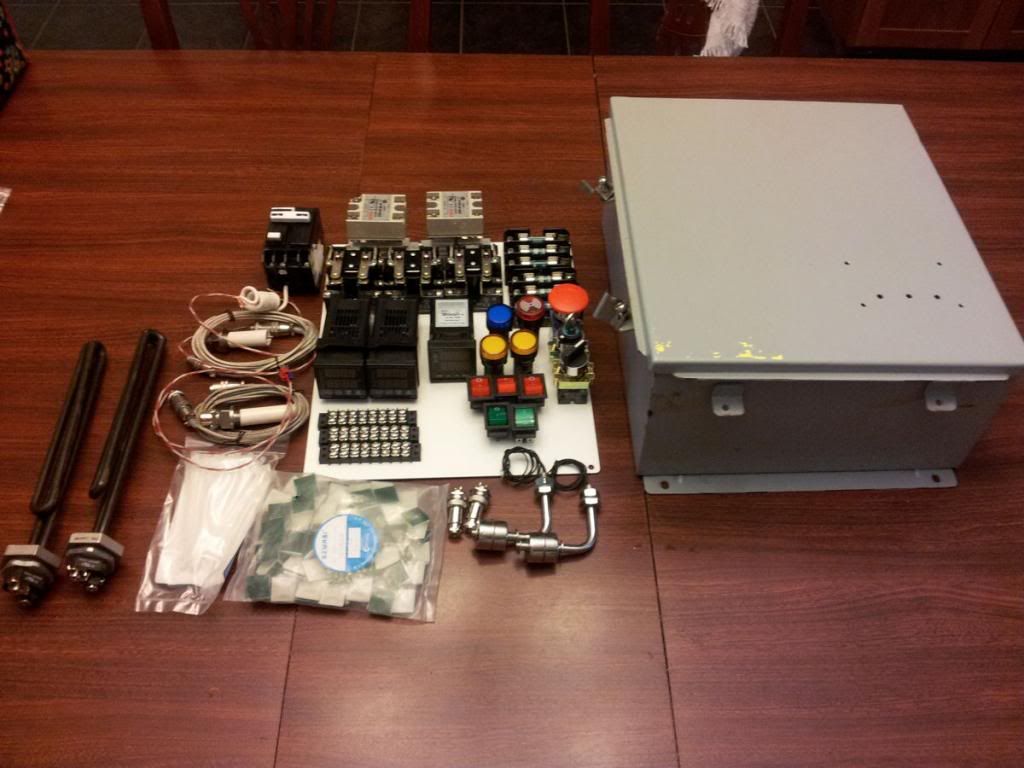
And here's the layout for the control panel:
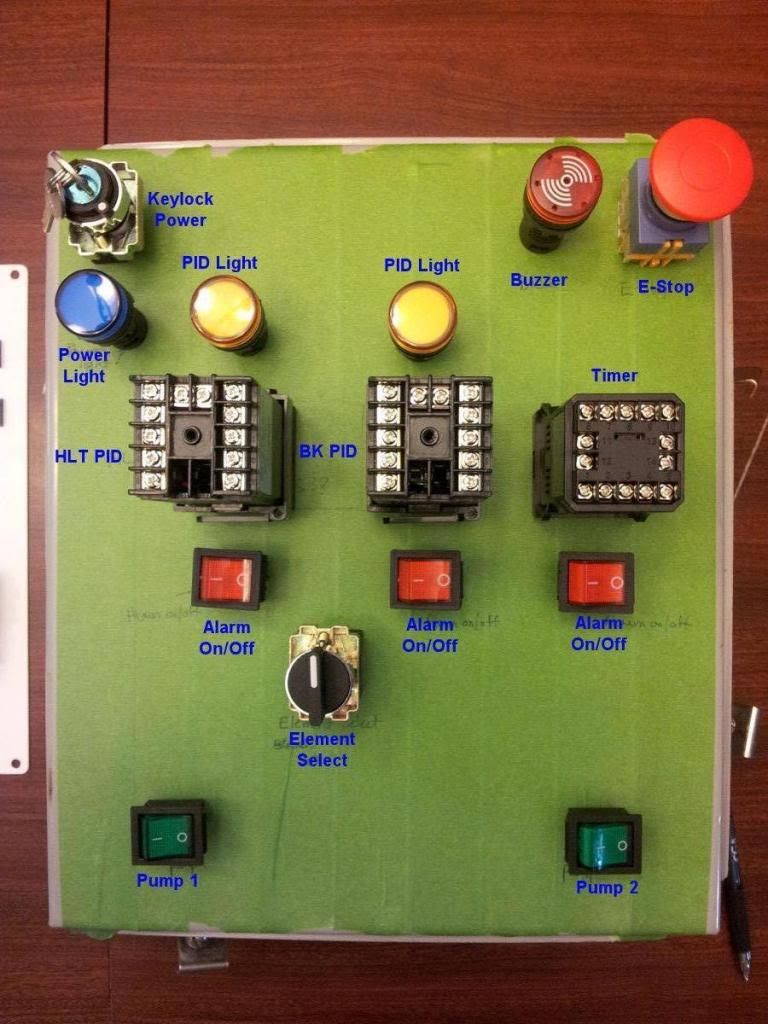
So I'd appreciate any thoughts, comments, and pointers moving forward. Thanks
Re: Everwood Avenue Brewery Build
Posted: Thu Nov 08, 2012 2:15 pm
by mr x
Should turn out good. Keep the pics coming.

Re: Everwood Avenue Brewery Build
Posted: Thu Nov 08, 2012 2:28 pm
by bluenose
I'm meeting an electrician tonight to go over the wiring of my basement. What kind of things should I discuss with him to allow for future electric brewing in said basement?
sorry to hijack your thread, but it seemed an appropriate place to ask
Re: Everwood Avenue Brewery Build
Posted: Thu Nov 08, 2012 2:34 pm
by GillettBreweryCnslt
bluenose wrote:I'm meeting an electrician tonight to go over the wiring of my basement. What kind of things should I discuss with him to allow for future electric brewing in said basement?
sorry to hijack your thread, but it seemed an appropriate place to ask
What you need to have is either a Spa Panel installed where you'd like the system to plug in (like where in the basement or garage you want the receptacle) or a GFCI breaker installed into the panel and a line run to a 4-conductor power receptacle (a dryer outlet). For this system you definitely need 4 conductor line (2 hot, 1 neutral, 1 ground).
You need to then decide if you want a 30A circuit or a 50A one. 30A is good for only running one element and pump at a time, whereas a 50A will allow you to run 2 elements at once. Running two is valuable if you want to do a concurrent double brew day - you can be heating up the strike water in the HLT while boiling the first brew. I went with 30A for now, but I can always upgrade.
Have fun,
Re: Everwood Avenue Brewery Build
Posted: Fri Nov 09, 2012 3:23 pm
by GillettBreweryCnslt
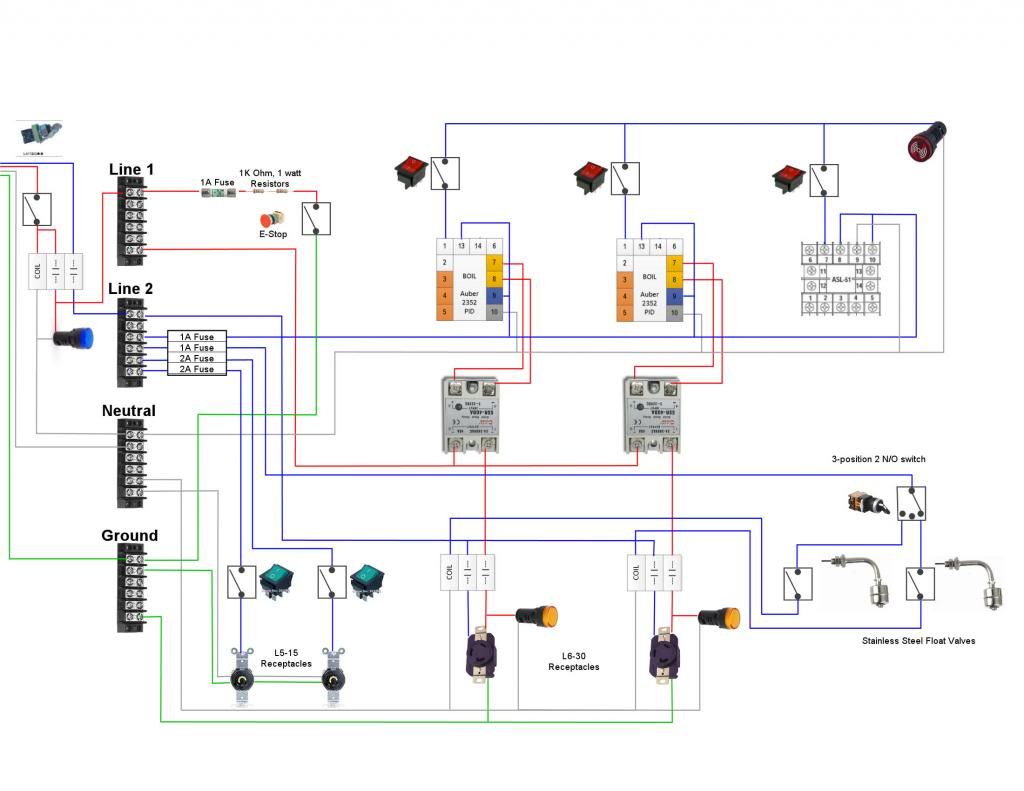
Ok, here is the wiring diagram. Damn it took me a while (probably 4 hours). Have a look, ask questions and please critique and point out any mistakes so I don't kill myself! Enjoy.
Re: Everwood Avenue Brewery Build
Posted: Fri Nov 09, 2012 3:26 pm
by Jimmy
Fishdisease wrote:Ok, here is the wiring diagram. Damn it took me a while (probably 4 hours). Have a look, ask questions and please critique and point out any mistakes so I don't kill myself! Enjoy.
I like your confidence

Re: Everwood Avenue Brewery Build
Posted: Fri Nov 09, 2012 3:37 pm
by RubberToe
Are those float switches on the lower right?
I wouldn't bother going with an actual bus for line 1 and ground as there aren't many connections.
BTW you're welcome to come take a look at my panel any time and I'll be brewing once or twice this weekend. Mine's wired very much the same... I use an illuminated switch for my element (the light and switch are on different circuits) instead of having the light and switch seperate.
Re: Everwood Avenue Brewery Build
Posted: Fri Nov 09, 2012 3:56 pm
by GillettBreweryCnslt
Indeed those are float switches. I stole the idea from someone else, but it seems like an easy way to prevent running the system when it's dry. They were only $10 and I think an excellent safety feature.
I just used the pictures of the bus for illustration. I have a few 8 terminal blocks so I was planning on splitting one for ground and neutral and another for line 1 and 2.
It was very educational to draw this myself, I have to say I reenforced a lot a basic electrical concepts that I otherwise would've just glossed over.
Re: Everwood Avenue Brewery Build
Posted: Fri Nov 09, 2012 5:49 pm
by GillettBreweryCnslt
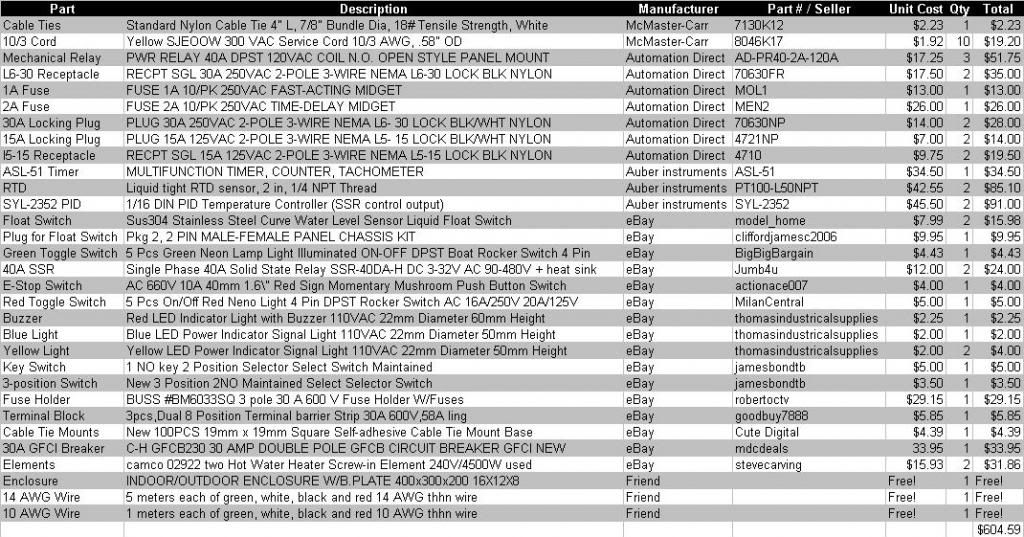
Since I hope this'll be a place to learn about this type of build, I'll also post my parts lists. This is the panel parts list and I'll post similar lists for the vessels and stand when I get there. I have to give a huge thanks to JohnG for the enclosure, it's awesome beyond belief.
Re: Everwood Avenue Brewery Build
Posted: Fri Nov 09, 2012 6:58 pm
by mr x
Don't understand the e-stop wiring. Also don't see the need for the contactors.
Re: Everwood Avenue Brewery Build
Posted: Fri Nov 09, 2012 7:12 pm
by LeafMan66_67
Now I'm curious. Will need to log on to computer to see it though.
Re: Everwood Avenue Brewery Build
Posted: Fri Nov 09, 2012 7:32 pm
by AllanMar
mr x wrote:Don't understand the e-stop wiring. Also don't see the need for the contactors.
e-stop shorts a small current to ground tripping the GFI? P-J on HBT is a big proponent of this method. Since he's using a main contactor anyway I would probably use that instead, but these two methods have been debated to great end on HBT.
I assume he wants the contactors to isolate both legs to the elements? Also to provide true isolation as I've seen SSRs at work fail on(much higher quality then the ones home brewers commonly use at that) I intend to do the same in my build.
Re: Everwood Avenue Brewery Build
Posted: Fri Nov 09, 2012 7:56 pm
by mr x
Reason 1000001 why HBT should never be consulted for anything. if you are running an emergency stop, you cut the power mains. Period.
I guess those contactors are there for the float switches. Points will stick on contacts as well, especially if they get hot. It's reasonable for protecting cheap equipment, not for personal saftey though.
Re: Everwood Avenue Brewery Build
Posted: Fri Nov 09, 2012 8:16 pm
by AllanMar
mr x wrote:Reason 1000001 why HBT should never be consulted for anything. if you are running an emergency stop, you cut the power mains. Period.
This method will cut the power mains? It could be argued better then cutting off a contactor as it will cut them before the power reaches the control panel. But that said I'm not a huge fan of this method either, and both cases have been debated extensively already.
Yes contactors can fail closed as well, but far less often. IMHO the more common failure state for a contactor is open, while it is not uncommon for an SSR to fail closed. The float and element selector switch could be wired on the LV side of the SSR, but the contactor is a better option as it isolates both legs.
Re: Everwood Avenue Brewery Build
Posted: Fri Nov 09, 2012 8:26 pm
by mr x
You are counting on the GFI to cut the power mains. A switch directly inline is the better (and in my opinion, only) method. Get rid of the keyswitch altogether and use a button capable of handling the power.
And I wouldn't say far less often. In my experience, SSRs burn open, and contacts burn closed (the coils go open, but that's another issue).
Re: Everwood Avenue Brewery Build
Posted: Fri Nov 09, 2012 8:41 pm
by RubberToe
About the e-stop, I studied many P-J diagrams for my panel and chose not to include one in my setup mostly for the reasons X states. IMO I would rather just turn the main power off to the panel and think it's dumb to create an intentional short. I know this is also what the 'test' button on a GFCI does, but still. I switch the panel power with a 110v switch and a contactor switching both hot legs. The reason I use contactors is simply to keep all the equipment on the front of the panel 110v.
I don't know about the contactors failing open or closed as I'm not an expert in the area. I have another contactor after my SSR controlled by a master switch for the element.
Re: Everwood Avenue Brewery Build
Posted: Fri Nov 09, 2012 11:14 pm
by GillettBreweryCnslt
Interesting debate, although almost offensive that you'd insinuate I just followed PJs diagram without a thorough understanding of the components. The truth of the matter is that there are several ways of cutting power to the box, all of which have failure points It all boils down to where you want to cut the power, the breaker, switch or somewhere inside the box.
So I have used two methods here, the e-stop and the 110v switch in front of the main line contactor. The reason I chose include the e-stop is that while putting a 110v switch will also cut the current to the box, there will still be current going to the switch. The e-stop cuts current at the breaker, killing it at the breaker eliminates all current, period. And in reality, the e-stop is just that,for emergencies, if it was used to turn off power on any regular basis, then yes it would be dumb. If I want/need to cutoff power just at the box then I have a 110v switch in front of the contactor. And I don't know about you guys, but I have a kid who I never want to be able to turn on the system, and the same goes for most of my friends and family. So the keyed switch stays.
The reason for the SSR/Contactor combo in front of the elements is to completely isolate both legs from the element. I assume that no one is suggesting that there be one live leg going to the element at all times as would happen if we remove the contactor from the element circuit. And the only other way to completely isolate both legs would be to use a $3 DPST selector switch, which imo has a higher probability of failure then a mechanical relay. The float switch is there to prevent an element from being fired up when it's dry.
I know from previous discussions that some of you would simply ground everything and rely on that, but I'd prefer to build in a few systems to reduce the likelihood of an issue if there's stray current somewhere. There is absolutely nothing wrong with being overly cautious. Electronically there is nothing wrong with a ground-to-short system either. A properly regulated current provides the exact same function as the test button on the GFI breaker and as long as you don't (ab)use it on a regular basis and exceed the specification of the number of cycles on the GFI then it's perfectly fine.
What disappoints me is that no one picked up the obvious mistake in the resistors, although it was a typo on my behalf. I'll actually be using either 2 x 2.5K 5W resistors or a single 5K 5W one. I'll assume you can do that math.
Re: Everwood Avenue Brewery Build
Posted: Fri Nov 09, 2012 11:46 pm
by mr x
The e-stop does not cut current at the breaker. It instructs the GFI to cut the current. Massive difference.
What is the point of disconnecting the power from the elements using a contacter? Why not just pull the plug? I understand that the float switches won't handle the current, so I see the point of contactors there.
Re: Everwood Avenue Brewery Build
Posted: Fri Nov 09, 2012 11:50 pm
by AllanMar
Fishdisease wrote:Interesting debate, although almost offensive that you'd insinuate I just followed PJs diagram without a thorough understanding of the components.
This was not my intent, so excuse me if I have unintentionally. I was actually attempting to justify your design.
Fishdisease wrote:What disappoints me is that no one picked up the obvious mistake in the resistors, although it was a typo on my behalf. I'll actually be using either 2 x 2.5K 5W resistors or a single 5K 5W one. I'll assume you can do that math.
This has also come up with P-J's diagrams a few times before. IMHO if you are on board with this method of E-Stop (as I said before I'm not trying to re-start a debate thats been had many times before) then the risk of 1W resistors is not significant. The only way this will be a concern is if the GFCI fails to operate, in which case there are many other concerns. Back to your GFCI test button comparison, the few GFCI's I have seen opened appeared to have a 1W or less test resistor. Again, this is another debate that has already been had elsewhere.
mr x wrote:The e-stop does not cut current at the breaker. It instructs the GFI to cut the current. Massive difference.
Do you also not agree when Shunt Trip breakers are used for this purpose? I have not seen any large scale E-Stop implementations that don't rely on contactors or shunt trip breakers to shutdown multiple machines.
Re: Everwood Avenue Brewery Build
Posted: Sat Nov 10, 2012 12:02 am
by mr x
Let me explain it this way. I do equipment lockouts as part of my job. That requires me to make sure equipment is safe for work by many different tradesmen. While the equipment may indicate the power cannot be energized due to interlocks, that isn't enough. I need to make sure the electrician has pulled the breaker, checked the power with a meter, and locked that panel so it can't be re-energized. And that's still only half the job, I am also required to go and check the power at the local switch. In this case, the GFI circuit is an interlock, a half measure. It would never pass muster as a safe way to isolate equipment. There isn't any discussion to be had on this, it's just plain dangerous.
FWIW, I don't use any of this stuff. The equipment is grounded, and when I want to work on something, I pull out the plugs.
Re: Everwood Avenue Brewery Build
Posted: Sat Nov 10, 2012 12:19 am
by AllanMar
We are not talking about lockout tagout? I fully agree this is not an acceptable means for lockout tagout but that is a totally different story, regarding occupational health and safety.
Interlocks for safety is a very common practice? The GFCI implementation is a bit of a grey area, but your making arguments against almost all the standard practices for these things.
E-Stops are not intended to prevent electrocution or to isolate equipment for maintenance.
Re: Everwood Avenue Brewery Build
Posted: Sat Nov 10, 2012 12:27 am
by mr x
To me, if you are hitting that e-stop, it's for personal safety, and that's lock-out level of safety.
As far a gfi's, they just aren't used in large industrial enterprises for the most part. That says it all to me.
Re: Everwood Avenue Brewery Build
Posted: Sat Nov 10, 2012 12:35 am
by RubberToe
mr x wrote:What is the point of disconnecting the power from the elements using a contacter? Why not just pull the plug? I understand that the float switches won't handle the current, so I see the point of contactors there.
The point of having a switch in front of the element is so that you can turn it off when you need to (boil over, overshoot temp, etc) without turning the PID controller off. The float switch is just a precaution so you don't run the element dry. The float switches should also control the contactor so they aren't handling the element current; they shouldn't at least... I didn't go back to the diagram.
Re: Everwood Avenue Brewery Build
Posted: Sat Nov 10, 2012 12:42 am
by AllanMar
mr x wrote:To me, if you are hitting that e-stop, it's for personal safety, and that's lock-out level of safety.
As far a gfi's, they just aren't used in large industrial enterprises for the most part. That says it all to me.
E-Stops just aren't implemented the way your referring in large industrial enterprises for the most part. That says it all to me.
haha, your not drawing me into the GFI debate again though.
Re: Everwood Avenue Brewery Build
Posted: Sat Nov 10, 2012 12:46 am
by mr x
Using an e-stop designed like that is not safe if it's covering personal safety. First step is a 3 day suspension, and the next is termination, and a lot of time in court if somebody gets hurt in either case. And in Alberta, everyone on the crew gets a drug/alcohol test. I've been around this racket too long to be talked into anything else.
