Beer in the news

General beer chit chat
Post Reply
User avatar
mr x
Mod Award Winner
Mod Award Winner
Posts: 13764
Joined: Fri Sep 24, 2010 5:30 pm
Location: Halifax/New Glasgow

Re: Beer in the news

Post by mr x » Sat Mar 15, 2014 11:26 am

An Irishman explains how his country became a beer ad

http://life.nationalpost.com/2014/03/15 ... a-beer-ad/" onclick="window.open(this.href);return false;
Image
When I was growing up in Ireland in the ’80s, St. Patrick’s Day meant two things: a day off school and a break from Lenten abstinence.

Back then, most Irish kids were expected to give up chocolate, or potato chips, or even all types of candy for Lent. It was always a struggle for a sweet tooth like me, but on Paddy’s Day (never, ever say “Patty’s Day” to an Irish-born person), all could be forgiven. Chocolate for breakfast, lunch and dinner. It was like a halftime break in the slog of Lent.

The same often applied for grown-ups too. It’s rare in the more-secular Ireland of 2014, but back then, many adults gave up alcohol for Lent. And just like the three-leafed shamrock, March 17 represented a holy trinity. A visit to mass, then the parade (usually consisting of some fire trucks, simple commercial floats and a visiting U.S. marching band), followed by a few drinks in the pub before dinner.

And yes, there would be dinner. Irish people have always liked to drink more than most, but St. Patrick’s Day was not the international carnival of binge drinking and debauchery with which it is now associated. In fact, until 1966, pubs in Ireland remained closed on St. Patrick’s Day.

The current incarnation of the festival has its roots in the early ’90s. Ireland was emerging from the spectre of sectarian violence in Northern Ireland, and economic stagnation south of the border. The successes of the Republic of Ireland soccer team made the country feel like it deserved to be heard.

And pretty soon, far corners of the world had a way to sample, or even pig-out on, what it meant to be Irish. Irish pubs started to pop-up from Buenos Aires to Beijing. And one brand saw the opportunity to fuel the open franchise: Guinness.

Like a combination of Tim Hortons, Roots and Molson in Canada, Guinness has styled itself as a portal to Irishness. The Guinness Storehouse in Dublin is now Ireland’s No. 1 tourist attraction. The building offers, arguably, the most-impressive view of the city’s skyline. Sampling the black stuff, or at least learning about its history, is part of the deal if you want to see the view. Even Queen Elizabeth II dropped by during her historic visit to Ireland in 2011. Although, much to Guinness’s disappointment, she just warily admired a glass of the stout.

Across the globe now, the alcoholic drink spearheads celebrations on, and around March 17. Here in Canada, Guinness has the website StPatricksWeekend.ca (sounds official, doesn’t it?), telling drinkers where they can go for the biggest party in their town. You want a silly hat for the parade? Guinness will set you up for that, too.

In 2009, Guinness even invented a new festival, placed conveniently six months before/after St. Patrick’s Day. Arthur’s Day is named after Mr. Guinness himself. It’s a series of concerts around the world, kicked-off by the raising of a glass to Arthur at 17:59, commemorating the year he started brewing.

Saint Patrick’s Day parades are colourful and fun events for families, and for anyone who’s proud of their Irish roots. And proud they should be. There is no country so small, or even at all, that has such a celebrated national day. And on Paddy’s Day, everyone is welcome to the party.

The problem for many, is that alcohol is front and centre. In fact, for many revellers, there is little else to it, apart from digging through their wardrobes to find green clothing. There is, of course, so much else to Ireland. You’ve heard it before: the poets, storytellers, musicians and dancers.

Ireland also has two unique national sports: hurling (once described as “[field] hockey mixed with murder”) and Gaelic football (somewhat like a cross between rugby and soccer). For 130 years, they have played fundamental roles in knitting together communities across Ireland.

They are governed by one association, that oversees every game played; from under-6s, to senior games played before crowds of more than 80,000 people. Both sports are only played by amateurs, meaning those heroes run hardware stores or sell you insurance.

At this time of year, this more active image of Ireland is lost in the pungent fog of green beer, polyester orange wigs and vomit. We Irish have no one to blame for this but ourselves.

We often hate ourselves for it, but we play-up to the image of the party-loving lunatics. Everyone loves a class clown, but he’s also expected to take all the jokes aimed at him. I will find myself cheerfully laughing along with one-liners about beer, or potatoes. And if I don’t, well then I’m that Irish guy with the feisty temper.

And it’s not just at the personal level. Tourism Ireland paints a great picture of a great country, but every TV ad features some attractive people sipping a pint of Guinness in a pub. The subtext being, if you want a drinking holiday, Ireland’s the place for you.

There is no getting away from the fact that Guinness is responsible for telling many parts of the world what being Irish is all about. So, perhaps the Irish government can convince its de facto global ambassador to jump on board. The country can use Guinness’s slick marketing machine to rebrand Ireland, or maybe just to add a few nuanced shades of green to what the world sees through those novelty shamrock glasses.
At Alexander Keith's we follow the recipes first developed by the great brewmaster to the absolute letter. :wtf:

User avatar
mr x
Mod Award Winner
Mod Award Winner
Posts: 13764
Joined: Fri Sep 24, 2010 5:30 pm
Location: Halifax/New Glasgow

Re: Beer in the news

Post by mr x » Sat Mar 15, 2014 10:16 pm

Hong Kong's Taste for Beer Evolves
In a City Where Industrial Lagers Have Long Ruled, Craft Makers Emerge

http://online.wsj.com/news/articles/SB1 ... 24406.html" onclick="window.open(this.href);return false;
Standing beside a stainless-steel fermentation tank, Rohit Dugar explained the concept behind his latest beer, Young Master Classic.

"It's a hoppy pale ale, but not too bitter," he said, pouring a small amount into a glass. It smelled of citrus zest and passion fruit.

"That's from the Australian Galaxy hops we use in the dry-hopping," Mr. Dugar explained.

It was a scene familiar to any fan of small-batch, artisanal craft beer: the gleaming brewing equipment, the bready smell, the bulging sacks of malted barley. The setting, however, was remarkable: the sun-filled but cramped fourth floor of a factory building overlooking Hong Kong's East Lamma Channel, container ships passing just a few hundred meters in the distance.

Mr. Dugar hopes his brewery, Young Master Ales, will revolutionize the drinking scene in a city where beer has long meant indistinguishable industrial lagers. And he isn't alone. This month, Young Master will be joined by three more Hong Kong breweries making their debut at Beertopia, a craft-beer festival now in its third year.

"After the first Beertopia [in 2012], craft beer just exploded," said Chris Wong, who runs HK Brewcraft, a home-brew shop in Central. "Hong Kong people love trying something new. This is known as a food heaven, so that bodes well for beer."

In the U.S., craft-beer sales have boomed even as the overall beer market stagnates. The Brewers Association now counts 2,483 craft breweries, defined as independently owned operations that produce less than six million barrels of beer a year. (By comparison, AB-InBev, BUD -0.95% the world's largest beer company, produces a total of 339 million barrels of beer a year.) Hong Kong's craft-beer market is still marginal, but Mr. Wong sees a recent surge of interest in home-brewing as a leading indicator.

"Home-brewing is the backbone of the brewing scene in any city," he said.

Mr. Dugar won last year's inaugural Hong Kong Homebrew Competition with his Hong Kong Black Ale, a roasty but light-bodied brew with hints of coffee and chocolate.

"I got more serious about home-brewing after I came to Hong Kong because, until a few years ago, if you wanted good beer, you had to make it yourself," he said.

Born in New Delhi, 34-year-old Mr. Dugar studied business at Dartmouth College in New Hampshire—where he also had his first taste of craft beer.

"The first one I actually remember is Old Brown Dog," a hoppy brown ale by New Hampshire's Smuttynose Brewing Company. His interest blossomed after he moved to New York, where he worked as an investment banker, and it followed him to Hong Kong when he took a job with Goldman Sachs in 2011.

His plan for Young Master was hatched not long after, when the sudden popularity of imported craft beer made Mr. Dugar decide there is a market in Hong Kong for local brews. "I want to use the best ingredients, never compromise—no filters, no pasteurization, no stabilizers, natural carbonation," he said.

Working with Ulrich Altbauer, a German-born brewmaster, Mr. Dugar dipped into his savings and rented three factory units in the seaside industrial district of Ap Lei Chau. After obtaining a food-factory license—a novel experience, since the government's Food and Environmental Hygiene Department had never licensed such a small brewery before—he had brewing equipment custom-made to fit the low ceilings and tight quarters of Hong Kong's concrete industrial blocks.

The next step was to make the beer, an evolving process as Mr. Dugar refines his recipes, which include the potent 1842 Imperial IPA; the Rye Old Fashioned, a rye beer matured with wood chips tossed in the fermenter, which gives it an oaky taste; and the Cha Cha Soba Ale, a light, dry beer made with unmalted Chinese buckwheat and matcha green-tea powder, meant to evoke the crispness of Japanese soba noodles. Mr. Dugar is brewing a high-proof version of the rye beer that will be aged for several months in barrels previously used to age rye whiskey, which Dugar hopes will lend it some of the spirit's sweet, spicy character.

Two kilometers to the east, another brewing venture is taking shape in Wong Chuk Hang, a strip of rusty old factories. New Empire Brewery will unveil its first beers—two pale ales, a stout and a series of one-off fruit beers—at Beertopia this month. Founded by 23-year-old Dan Rybinski, a former chef in the British Navy who "came to Hong Kong for a bit of holiday and never went back," and local partner Troy Woo, New Empire aims to produce a line of ales somewhere between the hop-driven American approach and the malt-forward British sensibility.

"There's a lot of people who jumped on the craft-beer bandwagon and go extreme, with these very hoppy or high-alcohol beers. Maybe because I'm British, I don't like that—I like balance," said Mr. Rybinski, who has been home-brewing with his father since he was a teenager.

Another brewing venture, Nine Dragons Brewery, is being launched by German expat Simon Siemsgluess, who has brewed previously at Bavarian wheat-beer giant Paulaner's operations in Germany and mainland China. Though he is still hunting for a suitable brewing space, Siemsgluess has already started producing a pale ale and pilsner in Hamburg for export to Hong Kong.

"The sooner I can start up in Hong Kong the better," he said. "After all, why would a city like Hong Kong not be able to sustain a number of microbreweries and brewpubs, seeing that Singapore, Beijing and Shanghai can?"

Compared with New Empire, Nine Dragons and Young Master, the Hong Kong Beer Co. is big business, though its projected yearly output of 5,000 barrels—about 587,000 liters—is tiny by international craft-beer standards. (Young Master's annual capacity is 1,500 barrels; New Empire's is 266 barrels.) Originally founded in 1995, the brewery was eventually shut down, and the brand and equipment were recently purchased by the founders of Singapore's successful Brewerkz brewpub, who tapped veteran American brewmaster Simon Pesch to head up their Hong Kong operation.

"We want to make a big impression right off the bat," said Mr. Pesch, former head brewer at Pyramid Breweries, one of the largest producers of craft beer in the U.S. He arrived in Hong Kong in January with plans to produce a line of five American-style brews—a golden ale, pale ale, India Pale Ale, amber lager and oatmeal stout—that emphasize hop aroma over bitterness.

"The big challenge is breaking the dominance of the macrobreweries in Hong Kong and carving out a niche for ourselves—so many of the taplines in this city are controlled by the major players," said Jeff Boda, co-founder of Hop Leaf, which imports and distributes craft beer in Hong Kong. Though more Hong Kong restaurants and bars are offering craft beer on tap, Mr. Boda says many are restricted by exclusivity agreements with mass-market brewers, which often pay for the installation and maintenance of draft systems.

"The market is out there, it's just getting the product to them," he said.

Local brews can be sure of a spot at Tipping Point, a brewpub opened last month by American-born chef Que Vinh Dang that will dedicate 10 of its taps to craft beer. Three others will be connected directly to the bar's own brewing tanks, squeezed into a small back room on the ground floor of the pub's Wyndham Street space.

"There are so many possibilities in terms of flavor profiles," said Mr. Dang, an avid home-brewer whose previous creations have included a coffee and caramel porter, a honey rye IPA and a sticky-rice lemongrass beer with Citra hops that "came out smelling like litchi."

If the reaction to Mr. Dugar's beer is an indication, experimental brews could be an easy sell. "I drink a lot of wine and I don't normally like beer—but I like this a lot," said Kathy Wong, an education worker who visited Young Master's brewery after her friend Ashley Ho read about it online. Sitting in the brewery's tasting room, she took a sip of the Hong Kong Black. "This one is my favorite. It's not very strong on the first taste, but the aftertaste is very complex."

Ms. Ho was partial to the 1842 Imperial IPA—so partial, in fact, that she bought a two-liter growler to take home with her. Later, the pair paid a visit to the Globe, a Central pub, to try different kinds of craft beer.

"And we just bought tickets to Beertopia," said Ms. Wong. "I think these beers are very special. I've never tasted anything like this before."

"There definitely is an appetite for craft beer and if it's locally made, people are willing to pay a bit of a premium," said Stuart Bailey, general manager of Diversified Events, which runs the Restaurant & Bar Hong Kong trade show and the annual Hong Kong International Beer Awards. "I'm feeling a bit smug at the moment because I predicted this five years ago and nobody quite believed me."

The first Beertopia event, created by Jonathan So to introduce craft beer to Hong Kong, drew more than 1,000 people to the historic Western Market in 2012. The next year, Mr. So moved the festival outdoors, to the West Kowloon waterfront.

"We spread it across a whole day, with room for 6,000 people, and we still sold out of tickets," he said.

This year's edition will span three days, March 13 to 15, and offer more than 400 beers from around the world, including unusual offerings like tea-flavored beer from Beijing's Great Leap Brewery, a Belgian quadrupel aged in red-wine barrels by Denmark's Mikkeller and a beer made with mikan, a citrus fruit, by Japan's Baird Brewing.

Beyond the festival, craft beer is available at more and more bars, including the Roundhouse, which boasts 24 taps, and the Globe, which has installed a new 18-tap system to complement its extensive selection of bottles. Other standbys include Stone's, a Tai Hang bar with a rotating selection of draft beers, the Beer Bay, which specializes in bottled British ales, and Dickens Bar, which has recently expanded its selection of craft beer on tap and in bottles. There's a growing array of retail shops, including the Bottle Shop, Craftissimo and Sips, that specialize in bottled craft beer. HK Brewcraft offers both bottles and takeaway draft beer. Importers Hop Leaf and Americraft both maintain extensive online shops, with home delivery.

Hong Kong brewers

Young Master Ales

Brewing since: 2013

Beers: Cha Cha Soba Ale, Young Master Classic, 001 IPA, 1842 Imperial IPA, Hong Kong Black, Golden Era Old Fashioned.

Website: http://www.youngmasterales.com" onclick="window.open(this.href);return false;

Hong Kong Beer Company

Brewing since: 2014

Beers: Big Wave Bay IPA, Dragon's Back Pale Ale, Gambler's Gold Golden Ale, Hong Kong Amber Lager, Sevens Oatmeal Stout

Website: hkbeerco.com

New Empire Brewery

Brewing since: 2014

Beers: American Pale Ale, Pale Ale, Apricot Beer, Orange and Honey Ale, Raspberry Beer, Stout Porter

Website: None yet

Nine Dragons Brewery

Brewing since: 2014

Beers: New Territory Pilsener, Nine Dragons Pale Ale

Website: None yet

Tipping Point Brewing Company

Brewing since: 2014

Beers: Witbier with kumquat and ginseng, brown ale with honey and hazelnuts, hoppy pale ale

Website: tippingpointbrewingco.com

Typhoon Brewery

Brewing since: 2010; on hiatus since 2012, pending relocation

Beers: T8 English bitter, Eastern Lightning pale ale

Website: facebook.com/typhoonbrewery

Beer glossary

You may know that beer is a fermented malt beverage flavored with hops. But what exactly is "malt"? Or "hops"? Here's a quick user's guide:

Ale: Beer made with a yeast that thrives at warmer temperatures, producing complex fruity flavors.

Barrel-aging: Storing beer in barrels for several months to impart a woody character. Used wine or whiskey barrels are popular as these can add complexity to the beer's flavor.

Fermentation: The conversion of sugars into alcohol by yeast, added to the wort after boiling.

Hops: Flowers added to boiling wort to add flavor, aroma and bitterness to offset the sweetness of malt. There are more than 80 varieties, many with very distinct flavors.

Imperial: Adjective attached to high-alcohol versions of ordinary beer styles, traced back to extra-strong English stouts made for export to the Russian imperial court.

India Pale Ale: Strong, hoppy beer originally brewed to survive the long voyage from England to India, but reinvented by American brewers who added citrusy, fruity or piney West Coast hops.

Lager: Beer made with a bottom-fermenting yeast that can withstand cold temperatures, creating beer that is crisper and clearer than ale.

Malt: Malted barley or wheat, the basis of beer. Other starches such as rye, rice, buckwheat or potato may be used, usually in addition to malted barley or wheat.

Malting: Soaking grain in water and then drying it with hot air, creating enzymes that allow its starches to be converted into fermentable sugars.

Pilsener: Light-colored lager made with noble hops, which have low bitterness.

Quadrupel: A style of beer that achieves a rich, raisiny flavor and high alcohol content thanks to four times the usual amount of malt and the addition of "candi sugar," which makes fermentation easier. Dubbel and tripel are related Belgian styles.

Stout: Ale with dark, roasted malts.

Witbier: Belgian-style wheat beer defined by added ingredients such as coriander and orange peel. Not to be confused with German weissbier, also known as hefeweizen, which contains no additives.

Wort: Beer before fermentation—a sweet liquid produced by steeping malt in boiling water.

Yeast: Microorganisms that convert sugar into alcohol; different strains can produce markedly different flavors.
Beer glossary

You may know that beer is a fermented malt beverage flavored with hops. But what exactly is "malt"? Or "hops"? A quick guide:

Ale: Beer made with a yeast that thrives at warmer temperatures, producing complex fruity flavors.

Barrel-aging: Storing beer in barrels for several months to impart a woody character. Used wine or whiskey barrels are popular as these can add complexity to the beer's flavor.

Fermentation: The conversion of sugars into alcohol by yeast, added to the wort after boiling.

Hops: Flowers added to boiling wort to add flavor, aroma and bitterness to offset the sweetness of malt. There are more than 80 varieties, many with very distinct flavors.

Imperial: Adjective attached to high-alcohol versions of ordinary beer styles, traced back to extra-strong English stouts made for export to the Russian imperial court.

India Pale Ale: Strong, hoppy beer originally brewed to survive the long voyage from England to India, but reinvented by American brewers who added citrusy, fruity or piney West Coast hops.

Lager: Beer made with a bottom-fermenting yeast that can withstand cold temperatures, creating beer that is crisper and clearer than ale.

Malt: Malted barley or wheat, the basis of beer. Other starches such as rye, rice, buckwheat or potato may be used, usually in addition to malted barley or wheat.

Malting: Soaking grain in water and then drying it with hot air, creating enzymes that allow its starches to be converted into fermentable sugars.

Pilsener: Light-colored lager made with noble hops, which have low bitterness.

Quadrupel: A style of beer that achieves a rich, raisiny flavor and high alcohol content thanks to four times the usual amount of malt and the addition of "candi sugar," which makes fermentation easier. Dubbel and tripel are related Belgian styles.

Stout: Ale with dark, roasted malts.

Witbier: Belgian-style wheat beer defined by added ingredients such as coriander and orange peel. Not to be confused with German weissbier, also known as hefeweizen, which contains no additives.

Wort: Beer before fermentation—a sweet liquid produced by steeping malt in boiling water.

Yeast: Microorganisms that convert sugar into alcohol; different strains can produce markedly different flavors.
Hong Kong brewers

Young Master Ales

Brewing since: 2013

Beers: Cha Cha Soba Ale, Young Master Classic, 001 IPA, 1842 Imperial IPA, Hong Kong Black, Golden Era Old Fashioned.

Website: http://www.youngmasterales.com" onclick="window.open(this.href);return false;

Hong Kong Beer Company

Brewing since: 2014

Beers: Big Wave Bay IPA, Dragon's Back Pale Ale, Gambler's Gold Golden Ale, Hong Kong Amber Lager, Sevens Oatmeal Stout

Website: hkbeerco.com

New Empire Brewery

Brewing since: 2014

Beers: American Pale Ale, Pale Ale, Apricot Beer, Orange and Honey Ale, Raspberry Beer, Stout Porter

Website: None yet

Nine Dragons Brewery

Brewing since: 2014

Beers: New Territory Pilsener, Nine Dragons Pale Ale

Website: None yet

Tipping Point
Brewing Company

Brewing since: 2014

Beers: Witbier with kumquat and ginseng, brown ale with honey and hazelnuts, hoppy pale ale

Website: tippingpointbrewingco.com

Typhoon Brewery

Brewing since: 2010; on hiatus since 2012, pending relocation

Beers: T8 English bitter, Eastern Lightning pale ale

Website:
facebook.com/typhoonbrewery

At Alexander Keith's we follow the recipes first developed by the great brewmaster to the absolute letter. :wtf:

User avatar
mr x
Mod Award Winner
Mod Award Winner
Posts: 13764
Joined: Fri Sep 24, 2010 5:30 pm
Location: Halifax/New Glasgow

Re: Beer in the news

Post by mr x » Mon Mar 17, 2014 6:15 pm

The fight for LGBT equality will be won with beer
Corporate sponsors back off St. Patrick's Day parades

http://www.salon.com/2014/03/17/the_fig ... with_beer/" onclick="window.open(this.href);return false;
It’s one thing when the mayors of cities with strong Irish American populations take a stand and refuse to march in the St. Patrick’s Day parade. But when the beer companies back off, now that is major.

Earlier this month, both Boston Mayor Martin J. Walsh and new New York Mayor Bill de Blasio stated their intentions to sit out their respective St. Patrick’s Day parades until the events welcomed gay and lesbian participants. As Walsh said at the time, “Equality comes first. The fact that it’s 2014, I certainly hope we’re able to come to an understanding. It’s long overdue.” Mayor de Blasio issued a similar sentiment, noting, “I simply disagree with the organizers of that parade in their exclusion of some individuals in this city.” But though the mayors were applauded for their stands against exclusion, it’s been an unlikelier voice for change that’s been the most notable. Because as we Irish Americans know, we need a drink a lot more than we need a mayor if you want to get our attention. And this year, the Boston-based beer maker Sam Adams withdrew its sponsorship of its hometown parade, saying, “We were hopeful an agreement could be reached to allow everyone, regardless of orientation, to participate in this parade However, given the current status of the negotiations, this may not be possible.” German brand then did the same with its relationship with the New York parade, saying, “We believe in equality for all.” And then, in the deepest cut of all, Guinness, the liquid most closely associated with St. Patrick’s Day — right after street gutters full of urine — announced Sunday it too had had quite enough of this bigoted nonsense.

As the company announced in a statement, “Guinness has a strong history of supporting diversity and being an advocate for equality for all. We were hopeful that the policy of exclusion would be reversed for this year’s parade. As this has not come to pass, Guinness has withdrawn its participation.” And with that, it just got real.

Hilariously, angry old man Rupert Murdoch declared Monday that Guinness had been “bullied by gay orgs who try to take [the parade] over. Hope all Irish boycott the stuff.” First of all, yeah, I’m sure Guinness is really quaking at the prospect of legions of Rupert Murdoch fans abstaining from its beer. On St. Patrick’s Day. Second, it’s brilliant when people like Murdoch explain their homophobia as simply being about what’s appropriate at a “religious parade.” A religious parade that accepts beer sponsors – just like Jesus would!

It’ll take more than a somewhat drier terrain to deter a proud tradition like the St. Pat’s parade. As of Monday morning, Ford motors, which backhandedly says that “No one person, group or event reflects Ford’s views on every issue” was still supporting the New York parade, as well as CIE Tours International and Empire City Casino. But when corporations decide to act like human beings instead of corporations, it is a big deal. It says that excluding people because you’re uncomfortable with them is not okay. That’s not being bullied, that’s being right. Over the past few years, we’ve seen big brands like General Mills acknowledge that we live in a multiracial world and Honey Maid celebrate the fact that “wholesome” families don’t have to all look alike. And every time a brand recognizes that the mainstream is rich and diverse and that the angry shouting people who feel “bullied” whenever somebody requests equal representation are the goddamn lunatic fringe, it’s good for business. It’s good for everybody, in fact.

This won’t be the year that the parades in New York and Boston pulled it together and became more welcoming and tolerant. Okay, fair enough. But this will be remembered as the year that a tipping point was reached, one in which corporate America had to decide which side it wanted to be on, and it chose the side of love and tolerance and respect. And that is the whole lesson of the fight for equality. You can keep trying to lock everybody out, and eventually your world is going to get smaller and smaller. The real party, meanwhile, is happening all around, outside. It’s much wider and much nicer. And ours has the drinks.
At Alexander Keith's we follow the recipes first developed by the great brewmaster to the absolute letter. :wtf:

User avatar
mr x
Mod Award Winner
Mod Award Winner
Posts: 13764
Joined: Fri Sep 24, 2010 5:30 pm
Location: Halifax/New Glasgow

Re: Beer in the news

Post by mr x » Wed Mar 19, 2014 8:06 am

How Smart Skin’s nanotechnology is helping brewers save millions

Image

http://business.financialpost.com/2014/ ... -millions/" onclick="window.open(this.href);return false;
Walk into any of the world’s big breweries and you’ll likely see thousands of bottles shuttling along a series of mechanized pathways. The bottles, looking like a battalion of small soldiers, clang into one another as they flow though the various stations: cleaning, filling, capping, packing. It’s a route of multiple twists and turns, meaning there’s plenty of opportunity for a bottle to crack, leaving beer and glass on the production floor, not to mention a tiny dent in the company’s bottom line. The loss of a bottle or can on a production line — if regularly repeated — can add up to millions of dollars for a major brewer.

Now, Fredericton, N.B.-based Smart Skin Technologies product is being used by six of the top 10 beer brands in the world to help slash those costs, said Kumaran Thillainadarajah, the company’s founder and chief executive. And comparisons are being drawn to two other Fredericton-founded tech companies: Radian6 and Q1 Labs, both of which were recently bought by big Silicon Valley players.

One of Smart Skin’s technologies is a polymer film or “skin” that — using nanotechnology — can measure the pressure applied to it. The skin can be applied to a drone beer bottle or can, and then run through the production line. Rolling along the other bottles or cans, the drone reports — in real time — the pressure exerted on its sides. The line operator can then adjust the settings to ensure the pressure does not exceed the breaking point.

“It’s not uncommon to see broken glass strewn all over these plants, or to hear glass bottles breaking on the lines,” Mr. Thillainadarajah said.

An audit of one Smart Skin customer revealed that 0.5% of their bottles were breaking during production, he said. “0.5% sounds like a very small amount, but it turns out that was actually about $1-million in broken glass a year. And that doesn’t take into account down time and other downstream costs,” he said, pegging the total cost for the company, across its many factories, at upward of $100-million.

Smart Skin’s technology reduced the company’s breakage rate from 0.5% to 0.06%, Mr. Thillainadarajah said. “It has a huge impact on their business. It’s a return on investment typically measured in weeks or months, definitely not years.

“Once we started collecting this type of data, customers started coming to us very aggressively,” he added. “Every plant we’ve visited has immediately resulted in sales. Our best estimate is that probably every plant out there will want to be using this product.”

To be successful on a big scale, you can’t just concentrate on one thing…You don’t want to miss a sweet spot

Mr. Thillainadarajah, an international student from Sri Lanka, wouldn’t name his clients, but he says the list includes the majority of the world’s big beer brands, some top food producers and packaging and container companies. “Because the value proposition is so strong, all it takes is a demonstration to get a customer.”

Smart Skin, founded in 2009, launched its drone product last September. Just three months later, the company was profitable. And Mr. Thillainadarajah predicts 2014 will be a “big” year.

This growth has Gerry Pond making a bold prediction: Smart Skin has the potential to be as big as Radian6 and Q1 Labs.

Mr. Pond, who was named Canadian Angel of 2011 by Techvibes, was the first angel investor in both Radian6 and Q1 Labs. The two New Brunswick-founded companies were acquired in recent years by Salesforce and IBM, respectively, with Radian6 fetching more than $300-million. Pond was also the first angel to invest in Smart Skin, and he sees obvious similarities.

Most notably, all three companies sprung out of the University of New Brunswick. In the case of Smart Skin, Mr. Thillainadarajah conducted initial research in the computer engineering department. (Every member of the 14-person Smart Skin team studied at the university.)

And there are other similarities, including rapid growth. “Smart Skin has the potential to be of that scale. I think they’re on a trajectory equal to those companies,” Mr. Pond said, calling it a “great Canadian innovation story.”

Although he appreciates the compliment, Mr. Thillainadarajah says comparisons to Radian6 and Q1 Labs are “a little early.” “We certainly hope that way and believe we can, but it’s still very early days.”

Mr. Pond is not the only bullish investor. In mid-January Smart Skin announced a $3.9-million Series A investment round led by Rho Canada Ventures, Build Ventures and the GrowthWorks Atlantic Venture Fund. Jeff Grammer, a partner with Rho Canada Ventures, said he expects Smart Skin to “quickly dominate a large and growing market.”

The Series A money will help Smart Skin set up a European sales team. Mr. Thillainadarajah said it will also allow the company to develop new applications for its technology. Smart Skin is investigating applications in gaming, health care and sports. (Two big U.S. golf companies are paying Smart Skin to apply the technology to that sport, so golfers can easily measure and adjust their grip strength.)

Mr. Pond admits there’s a risk Smart Skin could spread its focus too thin, but he argues the company must explore all potential options. “To be successful on a big scale, you can’t just concentrate on one thing,” he said. “You don’t want to miss a sweet spot.”

That point is echoed by Mr. Thillainadarajah. “It’s very likely that the most important application for our technology is something we haven’t even thought of yet,” he said. “We’re just getting started.”
At Alexander Keith's we follow the recipes first developed by the great brewmaster to the absolute letter. :wtf:

User avatar
mr x
Mod Award Winner
Mod Award Winner
Posts: 13764
Joined: Fri Sep 24, 2010 5:30 pm
Location: Halifax/New Glasgow

Re: Beer in the news

Post by mr x » Mon Mar 24, 2014 1:28 pm

Blue Jays split with Steam Whistle, leaving Rogers Centre with no craft beer
Steam Whistle co-founder says Jays were unhappy about the craft brewer’s Twitter feed.

http://www.thestar.com/business/2014/03 ... _beer.html" onclick="window.open(this.href);return false;
Image
By: Morgan Campbell Staff Reporter, Published on Mon Mar 24 2014

Steam Whistle Brewery and the Toronto Blue Jays are good neighbours — the beer company sits across Bremner Blvd. from the Rogers Centre, and co-founder Greg Taylor says game days have his place packed with beer-drinking fans.

But they’re no longer business partners. The Jays have terminated their agreement with the local brewer just a year after Steam Whistle set up a kiosk in level 100 of the Rogers Centre.

According to Taylor, the club broke the news in a meeting last week, citing displeasure with the management of Steam Whistle’s Twitter feed. Taylor says the club objected to Steam Whistle sending tweets about its Rogers Centre location, claiming they violated market agreements the Jays had with other brewers.

“I don’t know that there were any other issues,” Taylor says. “We had a good partnership. We made sure there was a constant supply of fresh craft Steam Whistle, and the fans seemed to love it. But they have their agreements and you have to be careful.”

Blue Jays officials wouldn’t elaborate on what caused the split.

“We are not going to make public comment on the details of our business relationships, nor the rumours and speculation about them,” said club spokesman Jay Stenhouse.

Taylor says he and the Jays had discussed the idea of Steam Whistle at the Rogers Centre for a few years before the brewer finally moved in last season.

Most other parks in Major League Baseball offer at least one craft beer at concession stands, and Pittsburgh’s PNC park, offers 13.

Options still abound for spectators who like beer with their baseball.

Rogers Centre concessions outlets sell beer from the Budweiser family, as well as Stella Artois and Alexander Keith’s and Rolling Rock.

But the end of the agreement with Steam Whistle leaves the Blue Jays without a locally-brewed craft beer at its home park.

If the Jays change their minds, Taylor says he’s ready to resume doing business with them.

“This is not about being part of corporate America’s baseball franchise. This is about having craft beer available in the park next door,” he says. “We’re fans of the Jays. We have no interest in dragging them through the mud. It’s unfortunate. We were very excited.”
At Alexander Keith's we follow the recipes first developed by the great brewmaster to the absolute letter. :wtf:

User avatar
hogie
Verified User
Verified User
Posts: 1173
Joined: Fri Apr 01, 2011 2:16 pm
Name: Hogie
Location: Charlottetown
Contact:

Re: Beer in the news

Post by hogie » Wed Mar 26, 2014 3:49 pm

Great story about Mikkeller and Evil Twin.

http://www.nytimes.com/2014/03/30/magaz ... .html?_r=0" onclick="window.open(this.href);return false;
A Fight Is Brewing
By JONAH WEINERMARCH 26, 2014

The creators of some of the most distinctive craft beers in the world are identical twins from Denmark who can’t stand each other.

Mikkel Borg Bjergso, a 38-year-old former high-school science teacher who runs the Danish brewery Mikkeller, stuck his face into a bag of hops and inhaled deeply. It was a rainy February afternoon, and Mikkel, who makes some of the world’s most inventive beer, was visiting de Proef, a Belgian brewery in the town of Lochristi. The hops had been processed into unctuous pellets that resembled cat food, and they released a ripe botanical stink heavy on lemon grass and cannabis. “That’s nice,” Mikkel said, crumbling a few pellets between his fingers and nodding approvingly at the sticky green smear they deposited on his thumb. They were specimens of a strain called Polaris, developed by growers in Germany, which Mikkel had asked de Proef’s proprietor, Dirk Naudts, to purchase for use in a new Mikkeller beer. “They’re very fatty,” Naudts said.

Unlike most brewers, Mikkel doesn’t own a brewery. A typical Mikkeller beer originates in his brain as a far-fetched question: What quality of fattiness would a beer obtain if you sprinkled popcorn into the mash? What would happen if you dumped in a load of mouth-numbing Sichuan peppercorns during the brewing? How much fresh seaweed would lend a beer the right umami jolt? He then finds his answers by proxy, outsourcing the actual brewing to facilities, like de Proef, owned and operated by other people. Mikkel draws up detailed instructions for these fabricators to follow — specifying malt quantity to the milligram, mash schedule to the minute, bitterness to the I.B.U. — and the first time he tastes his own beer is usually when the brewer sends him a shipment and an invoice. “I don’t enjoy making beer,” he says. “I like making recipes and hanging out.”

This way of working is known as “phantom brewing” or “gypsy brewing,” and Mikkel is one of its best-known practitioners. His creations are adored not only on aficionado websites but also by chefs at Michelin-starred restaurants like Noma, in Copenhagen, and El Celler de Can Roca, in Girona, Spain, each of which enlisted him to design beers for their menus. As a phantom, Mikkel can source unwashed seaweed from the western fjords of Iceland, yuzu from Japan and avocado leaves from Mexico while leaving someone like Naudts to deal with the nitty-gritty of putting such ingredients into a beer someone might actually drink. And because he has so little overhead, Mikkel doesn’t have to worry about appealing to mass tastes. Which means more creative freedom. In any given year, a typical craft brewery produces maybe 20 different beers. Last year, Mikkeller made 124.

The number of phantom brewers is growing, and Mikkel, who got into the game in 2006, views this with a mixture of magnanimity and trendsetter’s pride. But he pays particularly close attention to one Brooklyn-based phantom brewery, because it is owned by his identical twin, Jeppe Jarnit-Bjergso. Jeppe started his brewery four years after Mikkeller began and, in an act of winking provocation, named the outfit Evil Twin. It is a smaller operation than Mikkeller, but similarly well regarded among connoisseurs. (Jeppe used to help Noma curate its beer selection.) The Bjergso brothers have opposite temperaments: Mikkel is reserved; Jeppe is an extrovert. And they are not on good terms, despite — or rather, because of — their shared infatuation with beer. They haven’t spoken to each other in more than a year.

The Danish press has caught the conflict’s biblical whiff, casting Mikkel and Jeppe as sworn enemies. Thomas Schon, Mikkeller’s first employee, told me that the twins suffer from a pronounced personality clash: “It was a big relief for Mikkel when Jeppe moved to Brooklyn. It was like the Danish beer scene wasn’t big enough for the two of them.” Mikkeller’s operations manager, Jacob Gram Alsing, said that the subject of Jeppe “is very sensitive for Mikkel to talk about.” Mikkel himself put it this way: “You know Oasis? The Gallagher brothers? They were one of the most successful bands in the world, but those guys had problems with each other.” With twins, he said, “it’s a matter of seeing yourself in another person, and sometimes seeing something you don’t like.”

Mikkel is tall and taciturn, with a solemn bearing that can make him appear extremely bored even when he’s in good spirits. “He can seem very arrogant and distant when you meet him,” his wife, Pernille Pang, says. “All my friends thought he was, at first.”

Wearing a black sweatshirt and worn bluejeans, he seemed underdressed for de Proef, a 70,000-square-foot operation that looks as if it might manufacture the occasional microprocessor in addition to its porters and pale ales. Through a spotless, two-story glass wall, a man in blue workman’s pants darted purposefully between nine steel brewing vessels, while a woman in a lab coat hustled up a staircase with a clipboard. Naudts is less beer geek than egghead: He describes his vocation as “applied research.” Last year, he installed a laboratory at de Proef that is outfitted with instruments for, among other things, moisture measurement, oil distillation, gas chromatography and mass spectrometry; three full-time lab technicians perform extensive diagnostic testing on hops, malts, spices and yeasts.

Mikkel had flown in from Copenhagen to check on a couple of Mikkeller beers in progress at de Proef and to witness the start of a brand-new brew, but these were largely ceremonial duties. For Mikkel, brewing has become primarily a discursive activity. “I get inspiration from tasting beers, food, coffees and wine, and from talking to people who have different ways of thinking about flavors and aromas,” he said. “Winemakers, coffee-makers, chefs, other brewers.”

Joining him were Alsing and an American named Chris Boggess, the head brewer of Three Floyds in Munster, Ind., known for its adventurous stouts. Mikkeller and Three Floyds have collaborated on several beers, and before leaving Indiana, Boggess procured a water-analysis sheet of Lake Michigan, which feeds Munster’s taps, for Naudts to replicate at de Proef. This simulated water would be used in a corn-heavy beer, called Majsgoop, that he and Mikkel were putting into production that day. “The water in Lake Michigan is pretty neutral,” Boggess said. “I think it just tastes really good with our yeast selection.”

Naudts said that when an ingredient’s effects are especially unpredictable — licorice, say, or shiso — “we send Mikkel a sample, he tastes it, and if he thinks the ingredient is too much or too low, we make a second, adapted brew and we blend them together.” But Mikkel rarely asks his contractors for sample batches, confident that a brew will come out as he intends. “When I do a recipe, it’s not difficult anymore,” he said. “I know what comes out of it.” He once bought $8,000 worth of truffles for use in a small-batch beer called the Forager. Schon, describing Mikkel’s facility with potentially overpowering flavors, told me later: “It’s all about balance. If you buy a blueberry beer, it’s got to have a clear, defined blueberry taste, but that’s No. 2. You want it to taste like beer first.”

The tale of the phantom twins has generated attention for both Mikkeller and Evil Twin, and while Mikkel acknowledges that “it’s a great story,” he regards it with some circumspection. “Our relationship is very complicated,” he said, adding, “I don’t see Jeppe as a rival.” He was unsure whether Jeppe regarded him the same way. When I mentioned my plans to meet Jeppe in the United States, Mikkel fixed me with a heavy gaze and sighed: “He’s going to talk so much trash about me.”

Jeppe lives with his wife and their two young boys in north Brooklyn, near Torst, a bar he co-founded and whose rarefied offerings he manages. On an early March afternoon, I met him at the bar, where he had happy news to share. “I’m here on an E-1 visa — a business visa,” he said, “but we’re changing it to an O-1, which is an artist visa. I just got preapproved last week.” He smiled. “Now I’ll have it on paper that I’m an artist.” Jeppe has shaggier hair than Mikkel and is far more gregarious. He sprinkles emails with exclamation points and showers casual conversation with the word “dude.” His New York friends include the musician Julian Casablancas, a fellow dad whom Jeppe chatted up one day as they watched their children at the playground. At Torst, he patted a stool, inviting me to sit, and asked, “You want some beer?”

The bar was fashioned from thick marble, and the walls were covered in wood salvaged from upstate barns. Mikkeller, which has contracted with brewers in Holland, Scotland and Norway and has bars in Copenhagen (where the company is headquartered), San Francisco, Stockholm and Bangkok, has greater global reach than Evil Twin; Jeppe concentrates on the American market, New York particularly. His beer is available at specialty shops and restaurants across the city, including Eleven Madison Park and Pok Pok. “Being a gypsy brewer, I don’t have my own brewery, so I couldn’t showcase beers at my own place,” Jeppe said. With Torst, that has changed. Mounted on a marble slab were 21 beer taps, a third of them devoted to Evil Twin; Jeppe had a $16,000, custom-built draft system called a flux capacitor, which allows the bartender to control the precise carbonation and temperature of each selection. Despite this elaborate rig, Jeppe said: “I didn’t want Torst to be just a geeky place, just for beer nerds. I like to go out sometimes and not only be around fat men that drink beer.”

Jeppe’s affability notwithstanding, he was full of bravado when it came to discussing business. “I wanted to change the beer scene in New York,” he said. “I wanted to show New York how to do it.” I ordered an Evil Twin beer called Bikini, a mere 2.7 percent alcohol by volume, and when I expressed surprise at its abundant flavor, Jeppe took a shot at his brother’s tendencies. “For me, drinkability is the most important,” Jeppe said. “I’m not gonna make a Dark Lord” — the ultrarich Three Floyds stout. “It’s a fun beer to try, but it’s undrinkable. I don’t want to sound like I put down my brother’s beer, but he’s in the line of Three Floyds a bit too much. He’s very fascinated with what they do. He makes this blueberry spontaneous” — a Belgian-inspired ale — “and I hate it. I think it’s disgusting. It tastes like Kool-Aid.”

Laughing, Jeppe told me about Bozo, a high-alcohol stout that he designed expressly to “make fun of” the extreme flavor experiments in which craft brewers like Mikkeller often engage. “We added cocoa, chocolate, coconut, cinnamon, oak chips, chili, coffee, vanilla, hazelnut, chestnut, marshmallows,” Jeppe said. “It’s not a beer I’d drink, but it came out excellent, and it gets crazy high ratings.”

Mikkel and Jeppe grew up in Niva, a small town 20 miles north of Copenhagen. Their father, Jens Borg Nielsen, was the warden of Vestre prison in Copenhagen; their mother did administrative work in the Danish Prison and Probation Service. When the brothers were 8, their parents divorced, and Nielsen, accepting a job at another prison, moved six hours north and had two more children.

The twins incorporated their mother’s surname, Bjergso, into their own, dropping “Nielsen.” “It was hard for my mom to have two kids, and we didn’t have a lot of money,” Mikkel recalled, “so I didn’t like the fact that my father had moved away and got a new family and didn’t show an interest in me. But I try not to spend time on being angry at people.” He described his relationship with Nielsen today as “very good”; Jeppe, whose feelings are much less sanguine, has replaced the vestigial “Borg”’ with “Jarnit,” his wife’s surname. The divorce, Jeppe told me, was “extremely rough,” but it had the effect of tightening the twins’ bond: “It was us against the world, always together. Defending each other.”

But they were also intensely competitive with each other, a dynamic that manifested early and sometimes comically. “Mikkel and I were born less than two minutes apart,” Jeppe told me. “He came first, but I was supposed to. He was laying the wrong way, and he came out through a C-section. If we’d been delivered the normal way, I would have been first. I like to say he made trouble before he was even born.” As small children, the twins competed to see who could empty the dishwasher faster, and such timed trials continued into adolescence. “From about 11 years old, we started middle-distance running, and we became really good,” Mikkel said. As Jeppe put it: “We always had someone we wanted to beat.” In 1994, the twins entered an 800-meter race at the Aarhus Games, an international track-and-field event. “It was our best race, and the difference between us was, like, one-hundredth of a second,” Mikkel said. “I came in second. Jeppe was third.”

Mikkel discovered craft beer while studying at Kansas State University, which he attended on a running scholarship and where he took chemistry and physics courses. His first taste was a bottle of Dead Guy, from Oregon’s Rogue Ales. “I remember thinking it was interesting,” he said, “but I didn’t pay attention. I went back to Coors Light, drinking what everybody else did. I loved the Silver Bullets. Remember those cans?” After freshman year, his passion for running waned, and he returned to Copenhagen, where he found “a beer revolution” underway, echoing the American craft-beer boom of the 1980s: “We had been completely dominated by Carlsberg,” Mikkel says, and “people got tired of it.” He joined a beer club started by Jeppe, where they and several of their friends drank and discussed the most interesting brews they could find. In 2005, Jeppe opened a beer store called Olbutikken, which became well known among beer drinkers. Mikkel, who worked as a science teacher, began home-brewing in his spare time with an old running pal named Kristian Keller. Forming Mikkeller in Mikkel’s kitchen, they found an early hit in Beer Geek Breakfast, a stout brewed with French-press coffee, which Jeppe agreed to stock. A year or so later, Keller left the business — he wanted to be a writer — and Mikkel took control of the company.

The arrangement between Olbutikken and Mikkeller was symbiotic. The store helped to put Mikkeller on the beer map; Mikkeller became Olbutikken’s marquee draw. There was an implicit pact between the Bjergso boys: One would stick to selling beer, the other to brewing it. In 2010, however, Mikkel opened a flagship Mikkeller bar a short walk from Olbutikken. It was not a bottle shop, but the business “started to create conflict” nonetheless, Schon said. “The agreement that they’d had fell apart.” Soon after the bar opened, Jeppe started Evil Twin, and things went downhill. “I don’t know the details, but how would you feel if your brother copied your entire business plan?” Boggess said. Schon recalls being with the twins around this time. “Mikkel would say, ‘Tell my brother this,’ and Jeppe would respond, ‘Tell my brother this,’ ” Schon said. “They were 10 feet apart, but they refused to talk to each other.”

Jeppe acknowledged that when the first Mikkeller bar opened, it felt divisive: “Mikkeller had always been my house brand, and when Mikkel opened his bar, I said, ‘If he’s not gonna do it for me, I’ll just do it myself.’ ” But Jeppe said that his real anger stemmed from a quarrel over a 2009 real estate transaction, when Mikkel tried, he said, to back out of a deal to purchase Jeppe’s apartment. “For me, it wasn’t about money,” Jeppe said. “It was about the coldness in how he did it. He was like, ‘I don’t care.’ I felt a betrayal, big time. That’s where it all went really wrong. We almost got into physical fights. We didn’t, but almost. This episode made me realize that just because we grew up together, just because we’re twins. . . .” Jeppe trailed off, then declared: “You don’t choose your siblings.” (Mikkel disputes Jeppe’s account.)

I asked Jeppe if he had talked through these grievances with Mikkel. “We went to therapy right before I moved to the States — like, couples’ therapy,” Jeppe said. These visits spanned several months, but he deemed them unproductive. “I was crying, I put myself on the spot, and he was pretty cold, just sitting there looking at me.” And yet, he said, the therapist had been Mikkel’s idea. “He probably feels it somewhere,” Jeppe said. He added that, not long ago, Mikkel emailed him, hoping to reopen a dialogue, “but I feel it’s worthless to even try anymore.”

“Jeppe, on some level, is a little more insecure than Mikkel,” says Keller, who has known the twins since adolescence. “Jeppe always seems like he needs to prove himself more. That’s why he talks more. Whereas Mikkel is not trying to convince you to like him. So he comes off more relaxed or sure of himself. I’m not sure he is, but he comes off that way.”

Still, Mikkel’s troubles with his brother clearly weighed on him, even as he tried to make it seem otherwise. Over dinner one night, I asked him if he’d visited Jeppe in America. “I’d like to see my brother’s bar,” he replied, with a touch of wistfulness. A beat later, he added: “But I have no reason to go there. I don’t really have a market in New York.” Later on, when I pressed him, he cast his troubles with Jeppe as an irreducible fact of genetics. “It’s being the same person,” Mikkel said in what became something of a refrain. “You’ll only understand it if you’re a twin.”

As we traveled through Belgium, Mikkel rarely mentioned Jeppe unless I did so first, and he was eager to quit the topic of his family for a happier one: beer and how he makes it. In the lobby of his hotel, he sat with his laptop, focused on business. “Our daily work is a lot about logistics,” he said. Mikkeller’s staff consists of fewer than a dozen full-time employees. “We could probably use more people,” he said, “but we have a really good group right now. I don’t want a big staff.” Mikkel likes to hire people with unlikely backgrounds. Alsing, before he came to Mikkeller, was a major in the Danish Army, serving a seven-month deployment in Feyzabad, Afghanistan. Mikkel told me that he had recently been charmed by a job applicant whose résumé began, “I worked in a forest with an ax and a chain saw. . . .”

Last year, Mikkel brought on a full-time art director, an American named Keith Shore, whose portfolio includes illustrations for McSweeney’s books and merchandise design for the Shins. (Shore is an acquaintance of mine.) His Mikkeller labels, featuring misshapen cartoon characters that evoke construction-paper cutouts, give the brand a look both whimsical and, in a market dominated by labels either unremarkable or garish, anomalously cool. Mikkel attributes Mikkeller’s success to the scrupulous attention he pays not only to beer but also to the context within which customers encounter it. “I hate to look at ugly things,” he said. “If I’m in a bar, and it’s ugly, I don’t want to be there.” He added: “I’d never put a good beer in a bottle that looked bad. The beer wouldn’t be good anymore.”

The day after our visit to de Proef, we headed south, toward several breweries that specialize in lambic ales. Lambics are produced by what’s known as spontaneous fermentation, in which wort, a sugary mush extracted from boiled starch sources, is poured into a shallow metal basin called a koelschip, where it is exposed to the open air, rich in bacteria and wild yeasts. The taste of good lambics — dry, sour, with varying degrees of funk — derives largely from a wild yeast called Brettanomyces, which in most beers is considered a contaminant. Mikkel calls spontaneous beers, which age in wooden barrels, “by far the most interesting, both to make and taste. When I do a recipe, I know what comes out of it. With lambics, though, it’s impossible, because what’s in the air now will be different tomorrow, and all barrels are different. It’s a lot more like winemaking. I think I’d do that if I could, instead of brewing beer. I like being not in control of everything.”

As we approached the town of Lembeek, he said: “You are about to meet the godfather of lambics. In the ’70s, no one was buying lambics anymore. They were almost dying out. This guy kept it alive.” We soon arrived at Brouwerij Boon, where the godfather in question, a 60-year-old man named Frank Boon, greeted Mikkel warmly. Inside, Boon gestured toward a set of windows that are thrown open during brewing season, which lasts from fall into early April. “We capture wild yeast from the surroundings,” Boon said. “Below 10-degrees Celsius, unwanted bacteria can live, but they don’t develop to a troublesome degree. If we keep brewing past then, the lambic tastes like sour soup. You can smell the change in the air, the grass growing. The beer gets goût de fin de saison — a nice name for something not very nice.”

In a cavernous storeroom, wooden barrels were fitted with blowholes that Boon’s crew had plugged with billiard balls; gases could escape during fermentation, nudging up the balls, which otherwise maintained a seal. When I asked Boon what he liked about Mikkel’s beer, he responded with a fable intended to praise Mikkel’s unorthodox, prolific creativity: “A bee is intelligent, but if you put it in a bottle and you point the opening of the bottle away from the sun, the bee will only fly toward the sun, and he will never escape. If you put 20 mosquitoes into the bottle instead, they may have no intelligence, but they fly in every direction, and one will be free in two seconds.” Mikkel raised an eyebrow gamely. “So you are saying I’m a mosquito?” he asked.

The lambics you encounter most commonly — fruit-flavor varieties made by relatively big brewers like Belle-Vue and Lindemans — are very sweet. Mikkel was eager to visit smaller producers, whose ales are subtler and scarcer. One of these was 3 Fonteinen, a venerated brewery in Beersel not much larger than an auto-body shop, where we arrived the next day. The head brewer was Armand Debelder, who has known Mikkel and Jeppe for several years and calls them “very special both.” Jeppe approached Debelder during the Olbutikken days about selling 3 Fonteinen in Copenhagen, and Debelder was charmed: “He had passion for the beer,” Debelder said. “When you talked to him, you felt it immediately.”

To celebrate Mikkel’s visit, Debelder fetched a dusty bottle of Millennium Geuze. Bottled in 1998, the beer has become a collector’s item. “This originally sold for the equivalent of 8 euros,” Debelder said. “I have heard of people selling bottles for €950 — crazy!” Among beer connoisseurs’ favorite descriptors for wild ales are “farmhouse,” “barnyard” and “horse blanket,” and as I tasted the 16-year-old geuze, I expected some serious horse blanket. But it was bright and crisp. “It tastes fresher than younger beers,” Mikkel said, shaking his head in amazement.

Mikkel believes that producing beer on too large a scale invariably hurts excellence. After Debelder mentioned Sam Calagione, whose Delaware-based Dogfish Head brewery makes some of America’s most popular craft beers, Mikkel said: “Sam’s a really good guy. But I don’t really like all of his beers. It tastes like he filters them. They’re not as extreme as when he started. I think, as he’s gotten big, he’s lost touch with the quality.”

Back in Copenhagen, several days later, I dropped in on the Mikkeller office, located on a busy thoroughfare in Vesterbro, above a Cantonese restaurant. In an hour Mikkel would join Boggess to check out a vast, white-tiled industrial space in Copenhagen’s meatpacking district, where Mikkeller plans to open a brewpub with the help of Three Floyds this year. That evening, Mikkel was co-hosting a private beer-dinner at a restaurant called Mielcke & Hurtigkarl. His desk lay at one end of a long room, overlooking a double-row of workstations where staff members quietly tapped at keyboards and murmured into phones. “Mikkel doesn’t like a lot of talking in the office,” Alsing told me. “If you need to have a conversation, or even a phone call, you go into the kitchen.”

The lighting fixtures and furniture, in complementary shades of fuchsia, grape and cobalt, were the work, mostly, of Verner Panton, a Danish designer whose psychedelically undulating creations Mikkel collects. “His designs were totally outrageous,” he said. “He used different colors, materials, shapes. He did what I want to do: What no one expects.” Mikkel didn’t mention it, but Jeppe is an avid Panton collector, too.

One recent weekend, I joined Jeppe in South Carolina, where he’d been invited to participate in the Charleston Wine and Food Festival. He gave a seminar on contract-brewing, a cooking presentation with the Pok Pok chef Andy Ricker and a private dinner at Edmund’s Oast, a gourmet brewpub. After these obligations were through, he drove across the Cooper River into Mount Pleasant, to a small brewery called Westbrook.

Evil Twin has been contracting with Westbrook for several years. “Like, 80 percent of their capacity is taken up by my beer right now,” Jeppe said as he pushed through the front door. Inside was Micah Melton, the chef de cuisine at Aviary, Grant Achatz’s high-concept Chicago cocktail bar. Melton had come to Charleston for the festival, too, and he and Jeppe were inaugurating a new collaborative brew that involved blueberries, cured raisins, lemon peels and a half-dozen other things. (For all his digs at Mikkel’s extravagant concoctions, Jeppe has a maximalist streak of his own.)

As Jeppe sniffed from a bag of Sorachi Ace hops and tasted a new beet-and-licorice-infused beer straight from the fermenting vat, my mind flashed to Mikkel doing the exact same thing across the world, at de Proef — the twins mirroring each other, with an ocean of resentments and recriminations between them.

This May, Mikkeller will hold its annual beer festival in Copenhagen, and as always, Mikkel has invited a select group of brewers, including Jeppe, to showcase their wares. In 2013, Jeppe pulled out at the last minute, upset by a heated email exchange with Mikkel. I asked if he would go this year, and he said that he’d already bought his plane ticket. “Do I want to go?” Jeppe asked. “I don’t know. Not really. But I think it would be more of a victory for Mikkel if I don’t, because then he can say, ‘He canceled again.’ ” Jeppe nodded solemnly. “Me showing up is gonna be worse for him.”

Jonah Weiner is a contributing writer for the magazine and a contributing editor at Rolling Stone.

Food & Drink Issue Editor: Jon Kelly

A version of this article appears in print on March 30, 2014, on page MM53 of the Sunday Magazine with the headline: A Fight Is Brewing. Order Reprints|Today's Paper|Subscribe

User avatar
mr x
Mod Award Winner
Mod Award Winner
Posts: 13764
Joined: Fri Sep 24, 2010 5:30 pm
Location: Halifax/New Glasgow

Re: Beer in the news

Post by mr x » Wed Mar 26, 2014 5:48 pm

http://m.theglobeandmail.com/news/natio ... ice=mobile" onclick="window.open(this.href);return false;


A German heli-skier who died in Monday in an avalanche in British Columbia’s backcountry has been identified as the head of a major brewery in Munich.

Bavarian media said the 45-year-old victim was Jannik Inselkammer, an influential Munich businessman and head of the city’s oldest brewery, Augustiner-Bräu Wagner KG.


Sent from my Nexus 4 using Tapatalk 4
At Alexander Keith's we follow the recipes first developed by the great brewmaster to the absolute letter. :wtf:

BobbyOK
Verified User
Verified User
Posts: 665
Joined: Wed Sep 29, 2010 10:27 am

Re: Beer in the news

Post by BobbyOK » Thu Mar 27, 2014 12:07 pm

mr x wrote:Blue Jays split with Steam Whistle, leaving Rogers Centre with no craft beer
Steam Whistle co-founder says Jays were unhappy about the craft brewer’s Twitter feed.

http://www.thestar.com/business/2014/03 ... _beer.html" onclick="window.open(this.href);return false;
Image
This makes the Jays/Rogers Centre situation even more laughable - two of the top Craft Beer stadiums in the league are named Coors and Miller. And it's real craft beer they have available:
http://www.thedailymeal.com/top-10-base ... craft-beer" onclick="window.open(this.href);return false;

BobbyOK
Verified User
Verified User
Posts: 665
Joined: Wed Sep 29, 2010 10:27 am

Re: Beer in the news

Post by BobbyOK » Thu Mar 27, 2014 12:16 pm

Decent TV spot on the Garrison brew-off winner. Global morning show:

http://globalnews.ca/video/1231356/whea ... ew-contest" onclick="window.open(this.href);return false;

Good job Traci.

User avatar
mr x
Mod Award Winner
Mod Award Winner
Posts: 13764
Joined: Fri Sep 24, 2010 5:30 pm
Location: Halifax/New Glasgow

Re: Beer in the news

Post by mr x » Thu Mar 27, 2014 12:20 pm

Man will drink just beer — no solid food — for the 40 days of Lent

http://news.nationalpost.com/2014/03/25 ... s-of-lent/" onclick="window.open(this.href);return false;
Image
Image
To Chris Schryer, beer is a hobby, a passion and a side job. And for the 40 days of Lent, it is also virtually the only thing keeping him alive.

“I look pretty healthy now, but by the end of the 40 days my wife figures I’ll look like a castaway on account of my bushy beard,” said Mr. Schryer on Monday, soon after finishing off the pint of ale comprising his afternoon snack.

Chris Schryer’s beer schedule

7:30 a.m.
One 341 ml bottle of Amsterdam Brewing Company doppelbock (the batch of thick, high-alcohol beer was prepared specially for Mr. Schryer’s fast)
One cup of heavily sugared tea

9:30 a.m. – noon
Three pints of watered-down juice

Noon
One pint water
One 341 ml bottle of doppelbock
One dose of multivitamins

1 p.m.
One pint of watered-down juice

Mid-afternoon
One review beer (Mr. Schryer is a beer reviewer). On Monday he drank a pint of Granite Brewery’s Peculiar Ale.

3 p.m.
One cup of heavily sugared coffee

7 p.m.
1 650 ml bottle of doppelbock

Bedtime
1 cup of herbal tea

Since March 5, Mr. Schryer, a 33-year-old Toronto web designer, has sworn off all solid food in favour of an all-beer diet.

And as Lenten fasts go, this is the real deal: Mr. Schryer is a devout Anglican at Toronto’s Church of St. Aidan and even got Reverend Lucy Reid to bless the 100 litres of German lager sustaining him until Easter.

Replacing food with beer, it turns out, is more a test of “spiritual discipline” than one might assume.

“Without being dramatic, it definitely is not fun; it’s challenging. Every meal time there’s challenge,” said Mr. Schryer, who has remained the primary cook for his wife and two children.

For three weeks, Mr. Schryer has started each day with a bottle of strong beer for breakfast, another beer for lunch and a large 650 ml bottle of beer for dinner.

Midway through the afternoon, he also drinks what he calls his “work” beer; one of the many brews he periodically reviews for his beer-based website, TorontoBeerBlog.com.

In between he keeps hydrated with a steady intake of watered-down juice and other “clear” liquids. “No dairy, no ‘nectars,’ no protein shakes or smoothies, etc.” he writes on his blog.

Virtually all of Mr. Schryer’s beer intake comes from a single 100-litre batch of doppelbock prepared specially at Toronto’s Amsterdam Brewing Co.

The choice of doppelbock was deliberate; it is a German lager ranked as among the world’s heaviest beers and imbued with just enough nutrients to stave off starvation.

“I would definitely be emaciated without the beer; the caloric value is just incredible,” he said.

Mr. Schryer estimates the German lager is providing him with 2,000 calories per day; just below the 2,350 to 2,600 calories Health Canada recommends.

On his blog, Mr. Schryer describes the taste of his Lenten beer as “sweet and malty, with caramel, biscuit and a bit of oats.”

Regardless, if sustained for any prolonged length of time, the all-beer diet would inevitably kill him. For all its surprising nutritional strength, doppelbock is light on protein and utterly devoid of fat.

A few more months of nothing but beer, and Mr. Schryer’s hunger would soon be complemented by extreme mental fatigue, scaly skin and a chronic sensation of feeling cold.

All-beer diets for Lent actually have plenty of Christian precedent. In the early 1600s, Paulaner monks in Bavaria are said to have maintained liquid diets during Lent fuelled almost exclusively by special batches of doppelbock.

According to legend, the monks feared the rich beer was too much of a Lenten extravagance and sent a cask of the brew to the Vatican for approval.

Rendered sour and rotten by the time it completed its journey to Rome, the beer is said to have received papal approval on a technicality.

In 2011, Iowa blogger J. Wilson resurrected the tradition, maintaining a 46-day fast on doppelbock that he eventually turned into a book, Diary of a Part Time-Monk.

He succeeded, but reflecting on the havoc it wreaked on his body, Mr. Wilson vowed two years later that he would never do it again.

“It can be done. But there must be some reason why monks don’t continue the practice to this day,” he wrote.

National Post
At Alexander Keith's we follow the recipes first developed by the great brewmaster to the absolute letter. :wtf:

User avatar
mr x
Mod Award Winner
Mod Award Winner
Posts: 13764
Joined: Fri Sep 24, 2010 5:30 pm
Location: Halifax/New Glasgow

Re: Beer in the news

Post by mr x » Fri Mar 28, 2014 8:24 pm

Scientific breakthrough holds promise for biofuels and beer!
Scientists at Johns Hopkins University tinkered with snippets of DNA to create the first synthetic yeast chromosome

http://www.salon.com/2014/03/28/scienti ... _and_beer/" onclick="window.open(this.href);return false;
A team of researchers at Johns Hopkins University genetically engineered an entirely synthetic yeast chromosome. Though it is just one out of 16 chromosomes that make up the genome. The team’s leader Jef Boeke told Popular Mechanics, ”Yeasts have 16 chromosomes, and we’ve just completed chromosome 3. Now it’s just a matter of money and time.”

Genetically modified organisms are not new; humans have modified plants to be resistant to viruses, or to harm insects. And of course, much needed debate swirls around the consumption of GMOS, and farming practices by generally harmful agro-giants like Monsanto.

In terms of modifying yeast, MIT Technology Review also points out that humans have been manipulating yeast for many thousands of years. The wild fungus has been tamed to help us bake bread and make beer. When scientifically modified, the yeast is used to produce medicine, and biofuel. Simple baker’s yeast was modified to produce tons of artemisinin acid which is then converted into artemisinin, which combats malaria.

A completely synthetic yeast could be genetically altered to create medicine and biofuels, such as corn ethanol, or even change the taste of our beer. This chromosome was first designed by scientists on the computer and was then spliced together by undergraduates in a “Build-A-Genome” class. These students strung together the base pairs (A, C, T and G) of DNA into 750 base pair long segments. Those chunks were then assembled by researchers into longer strands and inserted into the yeast.

Popular Science’s William Herkewitz (full disclosure, he was my peer at New York University) looked into what this means for the brewing industry. Herkewitz spoke to Chris Baugh, a research scientist at Sierra Nevada Brewing Co. Baugh spoke as a beer researcher and enthusiast and not as a spokesperson for the brewing company. He is excited about the possibilities this new scientific development could hold for the future of beer. He told Herkewitz:

“Right now, the issue brewers face is that a lot of yeasts will produce these amazing flavors, but they may not ferment right. But if you could tailor-make your yeasts, with the understanding of what genes code for the different flavor molecules, well, that opens the doors to the mass production of beer with totally untasted characteristics.”

However, it is unlikely that we’ll be sipping on synthetic yeast beer any time soon. Researchers have not yet synthesized the entire genome, and as of now the public is far from trusting anything GMO.

h/t MIT Technology Review, Popular Mechanics
At Alexander Keith's we follow the recipes first developed by the great brewmaster to the absolute letter. :wtf:

User avatar
mr x
Mod Award Winner
Mod Award Winner
Posts: 13764
Joined: Fri Sep 24, 2010 5:30 pm
Location: Halifax/New Glasgow

Re: Beer in the news

Post by mr x » Fri Mar 28, 2014 11:35 pm

Why are pub landlords in low spirits?
Many of us imagine that running a pub could be a great job, but a recent survey found it to be one of the most miserable jobs in the country, with long hours and relentless pressure. Pete Brown gave it a go behind the bar

http://www.theguardian.com/lifeandstyle ... ow-spirits" onclick="window.open(this.href);return false;
Image
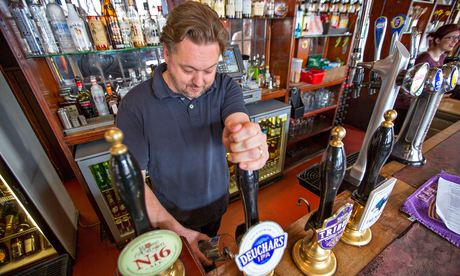
"Can you go round and check there's no dead bodies in the toilets, Pete?" asks Will, who has been showing me the ropes. "Flush anything nasty away and then lock them with the bolts at the top." As Petra, another member of the team, finishes mopping the floors, and Andrew, the shift manager, cashes up the tills in the office downstairs, I slump on to a bar stool, knackered. It's 12.30am.

It's not that my first shift behind a bar for over 20 years has been physically arduous. It's just that I'd forgotten what it was like to be alert and on duty at a time when I'm normally nursing a pint on the other side of the bar or thinking about going to bed.

And make no mistake – I've been lucky. Tonight was a quiet night in a good pub in a pleasant part of London.

"I once worked in a pub in the City," says Petra, "I lasted a week. No please or thank you, just 'Guinness', and the money thrown at you."

I haven't had to face anyone like the man who threatened to call the police when he decided his card had been cloned after sharing three bottles of wine with his wife, or the drunk woman who became violent and announced that she was a solicitor who was going to get this fucking place shut down – two customers Andrew had to deal with on the same night.

It's not just football supporters or stag nights that can make a bartender's life hell.

Last time I worked behind a bar I was a university student in St Andrews. It was mostly OK, apart from when alcoholic Old Course caddies threatened to kill me for being an English bastard, or possibly for being a 19-year-old with a stupid indie haircut.

Even then, I was lucky enough to avoid the tribulations faced far too often by my friend Emma, manager of the BrewDog bar in Camden. Despite brilliant support from her employers, there invariably seems to be more than she bargains for when she has to check the toilets.

"Why do men who need to be sick always do it in the urinal?" she asks. "The only way to clear it out from there is to scoop it by hand. And it's a law of pub nature that pub toilets only get blocked on a Friday or Saturday night when you can't get a plumber. Then it's a bin bag up to your shoulder, fisting the toilet bowl."

This is why my Twitter and Facebook feeds – which consist mostly of people who brew, sell or drink beer – are scornful when I announce I'm working a one-off shift in the Rose and Crown, in Stoke Newington, north London.

"Will you help pay the business rates and other bills? The beer bit is the easy bit! You need to be there for a few days taking part in deliveries, paperwork and cleaning to get a better idea," say Matt Wickham and his wife Karen, who run the Evening Star in Brighton.

I've done this shift to explore why working behind a bar is the ninth most miserable job in the UK, beaten by happier call centre workers, window cleaners, fork-lift drivers, and almost 300 other jobs, according to a survey published last week.

But if you work or have worked behind a bar and are nodding along, spare a thought for your boss. Rooted to the foot of the survey's table of results, below debt collection and "elementary construction occupations", is publican or manager of a licensed premises.

The regulars at the Rose and Crown have a hard time believing this. "Standing there pulling pints and having a natter is easy! And they always look happy enough," says one.

Martin Harley, who grew up working in the Rose and Crown for his parents and now runs a small chain of pubs, smiles in recognition. "Everyone has this idealised vision of how brilliant it would be to run a pub. People often tell me they're thinking about [doing] it and I always try to dissuade them."

Dawn Hopkins, who runs the Rose in Norwich, explains why. "Whatever kind of pub you run, you work very long hours for little reward. And the expectations are huge. As well as knowing your way around a beer cellar, you have to be a host, cook, cleaner and manager. You have to be good at marketing, social media, personnel management and finance."

Harley says: "I occasionally still jump behind the bar and pull a few pints and the regulars go, 'Oh look, he's working!' That's not work, that's the glory bit! The rest of the time I'm dealing with VAT returns, personal licences, designated premises supervisor licences for the shift managers, Environmental Health, Customs and Excise, the police. Today I had to go to the council offices to sort out a separate licence for the tables and chairs outside. And all that time, you're the landlord, they expect to see you in the bar. Even on your days off, people expect to be able to have a pint with you."

Kirsty Valentine, formerly of the Alma in Newington Green, north London, used to relish the challenge. But it took its toll. "To me, a 60-hour week would be quiet, like a 35-hour week for anybody else. Normally I'd be on 70 or 80 hours, more when there was a bank holiday or event. The upside is that when you're working with a great team, and the customers are friendly and you're giving them what they want and making them happy, it's brilliant. But when everyone else is off work, that's when you're busiest. You work weekends, bank holidays, Christmas and Easter. I used to manage one week's holiday a year, but I'd have to work extra hard and plan very carefully in the six weeks running up to it to make it happen."

Everyone I speak to tells me that to do the job well, you have to be fit – both physically and mentally. Most publicans are not. A recent survey by pub trade magazine the Publican's Morning Advertiser (PMA) revealed that 63% of licensees are overweight and unhappy about it, and more than half admitted to drinking more than the recommended 21 units of alcohol a week. A third said they do no exercise – not surprising when 60% of them work more than Valentine's "quiet" 60 hours a week.

All this makes the job hard enough. But throw in the context in which publicans are working, and it starts to look decidedly grim. On average, 28 pubs are closing for good every week. Despite relentless headlines about Britain's binge drinking problem, in reality alcohol consumption is in long-term decline. The beer market has shrunk by 23% over the last decade – and beer makes up 61% of the average pub's revenue.

While income is falling, costs are going up. Last week's alcohol duty freeze in the budget brings to an end a period where duty increased by 42% in five years. A third of the price of every pint is handed over to the government. And yet, another PMA survey showed the effect of duty increases is dwarfed by the impact of cheap supermarket pricing and soaring utilities costs.

But among the publicans I spoke to, one factor dominated conversations: the structure of the industry.

Over 22,000 pubs are owned by the pub companies (pubcos), large property businesses that emerged to absorb the pubs that breweries were barred from owning when the anti-monopolistic 1989 Beer Orders came into effect. It's difficult to write anything about the state of the industry these days without critics of the two largest pubcos, Punch and Enterprise, insisting that they are the biggest problem.

The pubco issue is fiendishly complicated, but a few common themes emerge. Many licensees feel they are misled about the leases they sign, and the conditions thereof. "I signed a lease that said I was liable for the full cost of repairs," says former Enterprise licensee David Montgomery. "Then they hit me with a bill for statutory compliance – £45,000, including the replacement of all the fuse boards in the building, some of which went back to the 1960s. I spent £120,000 on repairs in five years." Montgomery is unsure of his future, and undergoing counselling.

Peter Swanson is one of many who felt that he wasn't given the full picture when he signed his lease. "It soon became obvious the pub just wasn't viable. We poured money in, tried different menus, different beer ranges, nothing worked. When we spoke to Enterprise, they simply said, 'You signed the lease,' and that was it. We had to carry on paying rent that was based on much higher turnover than we were getting. We poured all our savings into it. It was meant to be a partnership, but when we said we couldn't carry on, they asked if we had any assets we could sell. Or any friends or family we could borrow money from?"

Swinson was eventually able to renegotiate his lease. But he admits that at the height of the crisis, he considered suicide. He says the rent reduction he was given was "too little, too late", and now, at 56, he faces bankruptcy and is looking for employment in his former trade, engineering.

Simon Townsend has inherited the situation after taking over as CEO of Enterprise Inns when the company's founder, Ted Tuppen, retired last year. (CEOs came second from top in last week's survey, which Townsend attributes to them being "driven".)

Townsend knows he has a role to play in improving landlords' lot. "It is beholden on people like me to try to improve the conditions for licensees, to help improve the situation around taxation and regulation, and to offer support. That is my responsibility."

He finds it "disturbing" if publicans are giving the impression of unhappiness to customers, but doubts they are. "Publicans are very good at separating their public personas from their private concerns. They're good at presentation. The industry would be in far greater difficulty if they were visibly unhappy."

This is perhaps why the regulars at the Rose and Crown in London find it impossible to accept that the people serving them might be miserable.

Tony Leonard, co-owner of the award-winning Snowdrop Inn in Lewes, Sussex, is not so sure this separation is healthy. He and his partner, Dom McCarten, recently emerged from a bruising battle with Greene King about the terms of other pub leases.

"The constant fear of losing everything if we faltered put a huge strain on our mental health and our relationship," he says. "Keeping up a cheerful appearance in front of customers when you're under siege from your 'business partner' doesn't help, and emphasises the disconnect between your role and your state of mind, which probably isn't healthy. It would have been indescribably worse if we had children depending on us, and I can easily understand why many people going through similar situations have suffered from depression, breakdowns, illness, alcoholism, family break-up and self-harm as a result."

There are happy pubco tenants – and unhappy publicans in freehouses. Even the happier ones freely admit that the job is tough. So what can be done to improve the wellbeing of the British publican?

From the CEO of the UK's biggest pubco to the staff at the Rose and Crown, the answer is unanimous: they want to be busier, to see more people come through the door. Sadly, that's not an easy ask. As the economy recovers from recession, the pub industry – always the pit canary for forthcoming financial woe – is significantly off the pace. Market analysts CGA Peach predict we'll lose another 8,000 pubs by 2018. "It's not that people aren't going out," says CGA's Scott Elliott, "but when they do, they want to eat food. The traditional wet-led boozer is suffering, while food-led pubs and restaurants are growing.

"Expectations are very high," he adds. "Things like WiFi, charging points and good quality or branded coffee have very quickly gone from nice-to-have to must-have."

Rob Willock, PMA editor, compares publicans to clergy, the profession that in last week's survey took the top spot.

"It's funny that they're at opposite ends of the table when so much of what they do is similar," says Willock. "They attract the congregation, dispense bread and wine, listen to people confess their sins and offer emotional support."

The difference being, one will be contemplating the promise of eternal life this weekend, whole the other could well be wrapping their arm in a bin bag, preparing to fist a toilet.
At Alexander Keith's we follow the recipes first developed by the great brewmaster to the absolute letter. :wtf:

User avatar
mr x
Mod Award Winner
Mod Award Winner
Posts: 13764
Joined: Fri Sep 24, 2010 5:30 pm
Location: Halifax/New Glasgow

Re: Beer in the news

Post by mr x » Sat Mar 29, 2014 11:55 pm

Free Craft Beer!

Image

http://www.nytimes.com/2014/03/30/opini ... inion&_r=0" onclick="window.open(this.href);return false;
CRAFT breweries may be a big story in the media these days, but they face much tougher challenges that most other small businesses.

Take the rules governing how beer is distributed, known as franchise laws, which were written decades ago and today are being used to limit consumer choice by keeping small and start-up breweries from moving easily into new markets.

Almost every state franchise law demands that breweries sign a strict contract with a single distributor in a state — the so-called three-tiered system. The contracts not only prevent other companies from distributing a company’s beers, but also give the distributor virtual carte blanche to decide how the beer is sold and placed in stores and bars — in essence, the distributor owns the brand inside that state.

This model was enacted in the 1970s, when the industry was a lot different: Back then there were fewer than 50 brewing companies in America and 5,000 distributors. Many small distributors carried beer only from one large brewer, and they needed protection in case the brewer they represented wanted to pull its product.

But today, while Big Beer remains big business, there are more than 2,700 breweries, and fewer than 1,000 viable distributors, so that relatively few distributors control huge sections of national territory, and each one can take on dozens of large and small breweries’ brands.

Nevertheless, state laws continue to empower distributors to select brands and manage them however they want — selling those they choose to sell, while letting other brands sit in their warehouses. The only recourse is to sue, and many small breweries lack even a fraction of the resources needed to take on a big distributor in court. As a result, they’re stuck with the bad distributor, which severely hampers their ability to perform and grow as a business.

Buy a small brewer a beer, and pretty soon he or she will be regaling you with war stories about fights with distributors.

For example, I once tried to terminate a contract with an underperforming distributor in New York for not only selling my products outside of his territory, but selling out-of-date beer. I thought it would be straightforward, since my contract said I could leave “with or without cause.”

But the distributor took us to court, saying the state’s franchise law, which sets a high standard for showing cause, trumped whatever my contract said. Two State Supreme Court rulings upheld my position, but, fearing a further appeal, I settled out of court. I was freed from the contract, but the legal fees and settlement cost Brooklyn Brewery more than $300,000.

Stories like this abound: My fellow craft brewers at Dogfish Head, in Delaware, faced a half-decade-long, six-figure legal dispute with a distributor just to terminate their contract.

Even worse, some small brewers refuse to enter certain markets because of the local distributors’ reputation. That’s bad for these businesses, and bad for the economy, but particularly bad for consumers, who would love to try the latest popular craft beers but can’t find them in their state.

Some states have remedied the distribution inequities. In 2012 Gov. Andrew M. Cuomo of New York and the State Legislature created a “carve out” from the state’s beer franchise law for the smallest brewers: If your brewery represents less than 3 percent of a distributor’s business, and you produce fewer than 300,000 barrels of beer a year (which covers all but the largest craft breweries), you can switch distributors by paying for the “fair market value” of the distribution rights, as negotiated by the brewer and distributor — still an expensive proposition, but easier than going to court.

North Carolina has a similar law, while in Washington State, small brewers are excluded from the state’s franchise laws completely. Just last week Michigan enacted a law allowing very small brewers to self-distribute. And several other states, including Massachusetts and Pennsylvania, are considering revising their beer laws to allow small brewers to do the same.

As the craft-beer sector expands, states are waking up to the economic benefits it offers — in jobs, tourism and taxes. Many states now offer subsidies and regulatory assistance for new breweries. But too few states have taken on the tougher job of pushing against distributors and their lobbyists.

For small brewers, the flexibility to change distributors or distribute their own products is essential to gain access to markets, increase consumer choice, grow and pour money back into the economy. The success or failure of a beer should depend on whether consumers like it — not on whether archaic distribution laws prevent them from finding it in the first place.

Steve Hindy is a founder and the president of Brooklyn Brewery and a member of the Brewers Association board of directors.
At Alexander Keith's we follow the recipes first developed by the great brewmaster to the absolute letter. :wtf:

User avatar
Joeg
Registered User
Registered User
Posts: 25
Joined: Sat Nov 09, 2013 12:22 pm
Name: Joe Godin
Location: Saint John NB
Contact:

Re: Beer in the news

Post by Joeg » Sun Mar 30, 2014 7:27 am

This is unfortunate and I hope it doesn't happen here in Canada.

http://boingboing.net/2014/03/28/fda-ru ... impos.html

Joe sez, "There's a new FDA rule that will make it nearly make it financially impossible for small craft brewers to give their grain away to farmers for animal feed. I work for a small brewery and all of us there are very upset about this and the general disregard for sustainability. At the end if the article linked there's direct FDA links that cover their proposal."

Leftover brewing grains have been fed to livestock since the dawn of agriculture, so this is a pretty radical shift. The proposed new requirements for animal feed handling stipulate that the feed has to be dried, analyzed and packaged before being donated to farmers (the spent grains are generally given away at the end of the brewing process), at substantial expense.

It's clear that food safety is important, but I'm not convinced that the stringency of this rule is commensurate with the risk.

Brandon Mazer is legal counsel for Maine’s largest brewer, Shipyard, which produces 400-600 tons of spent grain per week during its peak production seasons. Those grains are dumped onto a truck trailer and go to farms as feed.

“It’s a very big umbrella, and we got sucked under it,” Mazer said of the proposed FDA rule change. He said that no brewers in Maine, and few in the country, are equipped with the machinery, personnel or money to meet the requirements outlined by the FDA.

The Brewers Association, Beer Institute, American Malting Barley Association and other brewing organizations have voiced strong opposition to the new restrictions, calling for an exemption for brewers.

The Beer Institute says that in 2012 alone, U.S. brewers produced about 2.7 million tons of spent grain.

The FDA has extended the public comment period on this set of rules until March 31, and brewers and farmers that work with them say they are watching closely.
Primary Fermenter - West Coast Pale Ale

User avatar
Keith
Award Winner 6
Award Winner 6
Posts: 6479
Joined: Mon Sep 02, 2013 3:55 pm
Name: Keith
Location: Lower Sackville, NS

Re: Beer in the news

Post by Keith » Sun Mar 30, 2014 7:38 am

Imagine the financial impact this would have on brewers and farmers. I would probably be enough to put a few people under.
Brewer, Owner & Operator @ Ol' Biddy's Brew House
:cheers2:

User avatar
GuingesRock
Award Winner 20+
Award Winner 20+
Posts: 5190
Joined: Wed May 29, 2013 2:26 pm
Name: Mark
Location: Wolfville, NS

Re: Beer in the news

Post by GuingesRock » Sun Mar 30, 2014 8:35 am

Compost the spent grains instead, and sell the compost?
-Mark
2nd place, Canadian Brewer of the Year, 2015
101 awards won for beers designed and brewed.
Cicerone Program - Certified Beer Server

User avatar
Keith
Award Winner 6
Award Winner 6
Posts: 6479
Joined: Mon Sep 02, 2013 3:55 pm
Name: Keith
Location: Lower Sackville, NS

Re: Beer in the news

Post by Keith » Sun Mar 30, 2014 2:57 pm

That may work for the brewers, but the animals still need feed.
Brewer, Owner & Operator @ Ol' Biddy's Brew House
:cheers2:

User avatar
Joeg
Registered User
Registered User
Posts: 25
Joined: Sat Nov 09, 2013 12:22 pm
Name: Joe Godin
Location: Saint John NB
Contact:

Re: Beer news in the New Brunswick

Post by Joeg » Mon Mar 31, 2014 7:07 pm

Image

http://www.cbc.ca/news/canada/new-bruns ... -1.2593161

The price of beer has jumped in New Brunswick.

NB Liquor quietly increased the price of a 12-pack of domestic canned and bottled beer by 50 cents on Monday, including its discount brands.

"We offer the suppliers a chance to raise their price, but we don't collect any extra markup due to that, it's more to cover their costs," said spokesperson Marcelle Saulnier.

The price hike comes despite another year of poor beer sales in the province — a problem caused, in part, by already high prices.

For example, NB Liquor's annual reports show that over the past six years, the price it charges for bottled, canned and kegged beer has jumped an average of 11.7 per cent per litre, not including this week's jump.

Meanwhile, the numbers of litres sold in the province has dropped by 8.2 per cent during the same period.

Just last month, the Crown corporation's new CEO Brian Harriman, had said there are ways to bring in more revenue without raising prices on booze.

Harriman, who was hired away from Diageo, a global company that sells many well-known brands, such as Guinness and Captain Morgan, told CBC News he thought NB Liquor could bring in more sales through other means.

“I think we can through product mix … We can help consumers learn and understand more about spirits, more about wine, and find ways to stabilize the beer category, and get a bigger product mix in the basket," said Harriman, the first head of the Crown corporation hired through a non-political, outside recruitment process.

"There's probably a bigger opportunity to do it without necessarily driving price increases."

Three years ago, in his first budget, Finance Minister Blaine Higgs called on NB Liquor to improve its profit margin.

"We're relying on their creativity and ingenuity to do that," he had said.

But beer sales have plunged 12,000 litres a day in New Brunswick since then.
Primary Fermenter - West Coast Pale Ale

User avatar
mikeorr
Award Winner 3
Award Winner 3
Posts: 582
Joined: Wed Jul 17, 2013 12:09 pm
Name: Michael Orr
Location: Middle Sackville

Re: Beer in the news

Post by mikeorr » Mon Mar 31, 2014 9:49 pm

If it hasn't already, the NSLC is in the process of "adjusting" (aka increasing) their prices now....

As for the chart, I think it's very misleading - there's no way Alberta has the highest liquor prices in the country; when I was there last summer, I could find local NS & PEI products for cheaper than buying it here at home - and that's not even taking the Costco liquor stores into consideration!


Sent from my iPhone using Tapatalk

User avatar
jeffsmith
Verified User
Verified User
Posts: 4922
Joined: Tue Apr 26, 2011 4:18 pm
Name: Jeff Smith
Location: Amherst, NS
Contact:

Re: Beer in the news

Post by jeffsmith » Mon Mar 31, 2014 9:58 pm

mikeorr wrote:As for the chart, I think it's very misleading - there's no way Alberta has the highest liquor prices in the country; when I was there last summer, I could find local NS & PEI products for cheaper than buying it here at home - and that's not even taking the Costco liquor stores into consideration!
Agreed. AB has some of the lowest liquor prices I've seen in Canada.

User avatar
canuck
Award Winner 6
Award Winner 6
Posts: 1960
Joined: Wed Mar 07, 2012 11:54 am
Name: Shane
Location: Quispamsis, NB
Contact:

Re: Beer in the news

Post by canuck » Mon Mar 31, 2014 11:58 pm

FFS, so much for Harriman's recent statement about not increasing beer prices. I will say though that they've been doing a MUCH better job lately bringing in new beers.

chalmers
Moderator
Moderator
Posts: 5604
Joined: Thu Sep 23, 2010 4:17 pm
Name: Chris
Location: Halifax / On The Road Again
Contact:

Re: Beer in the news

Post by chalmers » Tue Apr 01, 2014 5:53 pm

That graphic is just plain wrong regarding the Alta beer pricing (unless there's some strange anomaly where 12 bottles are more expensive than 15 cans of the same volume) or they chose the most expensive retailer's price:

http://www.coopwinespiritsbeer.com/uplo ... _PRINT.pdf" onclick="window.open(this.href);return false;

15-pack of Molson Canadian cans is $22.99.

(Mind you, this is a "special", and the regular price is $31.99 for 15 cans) Keith's is $21.99 for 15 bottles (regular price is $25.99).

User avatar
mr x
Mod Award Winner
Mod Award Winner
Posts: 13764
Joined: Fri Sep 24, 2010 5:30 pm
Location: Halifax/New Glasgow

Re: Beer in the news

Post by mr x » Wed Apr 02, 2014 2:02 pm

Scientific breakthrough holds promise for biofuels and beer!
Scientists at Johns Hopkins University tinkered with snippets of DNA to create the first synthetic yeast chromosome

http://www.salon.com/2014/03/28/scienti ... _and_beer/" onclick="window.open(this.href);return false;

There was a bit on CBC Maritime Morning about this today. It was quite an extensive modification. Apparently 500 times to one piece of the DNA, the most ever. Was interesting to listen to if you can find it on archive.
At Alexander Keith's we follow the recipes first developed by the great brewmaster to the absolute letter. :wtf:

User avatar
Joeg
Registered User
Registered User
Posts: 25
Joined: Sat Nov 09, 2013 12:22 pm
Name: Joe Godin
Location: Saint John NB
Contact:

Re: Beer in the news

Post by Joeg » Fri Apr 04, 2014 7:04 am

I think this law should be challenged and a better way would be a trade agreement and not legislation.

http://www.cbc.ca/news/canada/new-bruns ... -1.2596826

A Campbellton lawyer is fighting what he calls an outdated law that limits the amount of liquor New Brunswickers can bring across the border from another province.

Mikael Bernard's crusade is timely, given the recent NB Liquor 50-cent price increase on a 12-pack of beer, which may have New Brunswickers looking to stock up elsewhere.

For Campbellton residents, that means making the trip just a kilometre away, to Pointe-à-la-Croix, Que.

But under the current law, the maximum amount of alcohol that can be legally imported into New Brunswick from another province is one bottle of wine or hard liquor, or 12 pints of beer, which is about 18 bottles or cans.

Offenders are subject to an automatic fine of $292.50 and their liquor is seized and destroyed.

'The last decision on point dates back to 1928, so it's been ages. And it's back during the prohibition period, so it will be interesting to see in this day and age, how the court feels.'
- Mikael Bernard, lawyer
Bernard is representing three people who are charged with having more than their limit.

"The last decision on point dates back to 1928, so it's been ages. And it's back during the prohibition period, so it will be interesting to see in this day and age, how the court feels," said Bernard, who is offering his services pro bono to anyone who wants to fight their importing charges.

His three clients are scheduled to appear in court in September.

Meanwhile, many Campbellton residents will continue to buy their booze in Quebec.

"It's a little more economical," said Doreen Tate.

In some cases, it's almost half the price — and getting better after the recent NB Liquor increase.

"I think if they wanna compete with Quebec, they're doing the wrong thing," said Campbellton resident Jim Adams.

"If they want the prices to be comparable, then they're going to have to match the prices over there."

Quebec store owners approached by CBC News said many of their customers come from New Brunswick. But none of them would agree to an interview because they said they fear speaking out would only lead to a raid, or more scrutiny for their customers or their business.
Primary Fermenter - West Coast Pale Ale

chalmers
Moderator
Moderator
Posts: 5604
Joined: Thu Sep 23, 2010 4:17 pm
Name: Chris
Location: Halifax / On The Road Again
Contact:

Re: Beer in the news

Post by chalmers » Fri Apr 04, 2014 8:59 am

Does anyone know the limits on bringing beer into NS (looks like NB is ~6L)? I wonder if bringing beer from the US (or QC) to NS, through NB, you need to obey their importation limits, as the final destination isn't that province.

Post Reply

Return to “General Beer Discussion”

Who is online

Users browsing this forum: No registered users and 2 guests